
Beef Wellington
Learn to make a restaurant quality beef wellington at home with perfect medium rare beef & crisp, flaky pastry every time. This foolproof recipe guarantees success!
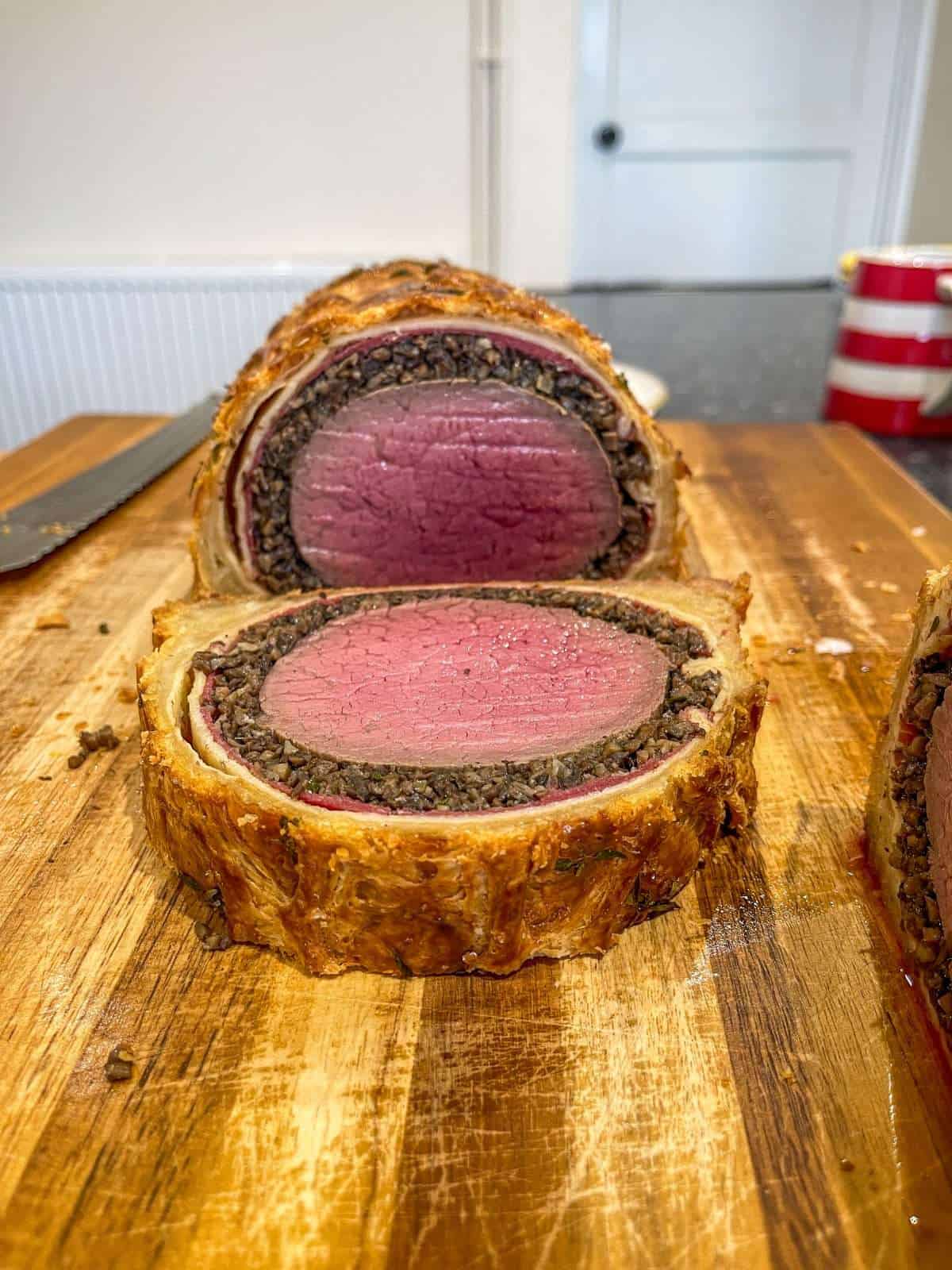
Here’s how to make a restaurant quality beef Wellington at home, completely from scratch!
This classic beef dish has a reputation for being quite difficult to make but this easy to follow recipe breaks it down into simple step by step instructions so you get it right the first time & every time you make it after that.
Inside crisp, golden flaky pastry you’ll find a tender medium rare fillet of beef, rich mushroom duxelles, delicate slices of bresaola & a layer of buttery crepes to keep the pastry perfectly crisp. All of these components come together to make an impressive beef dish that’s perfect for special occasions.
Follow this guide and you’ll be able to make beef wellington with confidence. It’s a brilliant dish for dinner parties, celebrations and any meal where you want to impress. I’ve been making beef wellingtons at home & in restaurants for a few years now & I’ve picked up quite a few handy tips & tricks that will take yours to the next level!
For more dinner inspiration check our our ever growing collection of main course recipes! There’s lots to choose from here, from homemade pies, slow cooked meat, barbecue, pasta dishes & more. And for a side to serve with this chicken, take a look at our side dish recipes.
Why This Recipe Works
Beef wellington has a reputation for being quite difficult to make. This easy to follow recipe takes away the guesswork & ensures that you get it right every time. Whether it’s your first time making it or your tenth.
- Perfectly cooked beef every time
Cooking the expensive fillet of beef perfectly is the most stressful part of making a beef wellington. This recipe is designed to give you perfectly cooked beef & there’s a full temperature guide included so you can cook yours exactly how you like. - Crisp pastry with no soggy bottom
A thin layer of homemade crepes inside the wellington keeps the pastry crisp & flaky instead of soggy & soft. We’re using a unique baking method that’s designed to crisp the bottom of the wellington up properly. - More flavour than traditional versions
Where classic wellingtons are made with prosciutto, this one’s made with bresaola for another layer of beef flavour. - Easy step by step process
Each stage of making this beef wellington is broken down into simple, manageable steps, making this dish easier to make than you’d think. - Flexible 3 day process
Each component can be made ahead of time, making it ideal for when you want to get ahead.
Ingredients For Beef Wellington
There’s quite a few variations of the classic beef wellington, although there are a few non negotiables (fillet of beef, mushroom duxelles & flaky pastry). Here’s what we’re using in ours.
Ingredient Overview
- Centre Cut Fillet Of Beef
- Mushroom Duxelles
- Bresaola
- Crêpes
- Flaky Pastry
Fillet Of Beef
The main attraction! We’re using a 1 kg piece of centre cut fillet, which will serve at least 6 people. A dry aged piece of fillet provides the best flavour! If you wanted to make a bigger wellington, use a bigger piece of beef. The process is still the same. Using a centre cut fillet of beef ensures that the meat cooks evenly throughout the Wellington.
We’re going to be cooking our beef medium rare, which in my opinion, is the best way to serve a classic beef wellington. Although I’ve also included a full internal temperature guide so you can cook your wellington however you like!
Mushroom Duxelles
Next up is our mushroom duxelles. This is a classic French mushroom filling that has a paste like texture & is made with finely chopped mushrooms, shallots, garlic, fresh thyme & a splash of sherry.
The key here is cooking the finely chopped mushrooms until all of the moisture has been evaporated. For the most flavour, it’s best to use a mix of mushrooms (I’ve used portobello, chestnut & cup mushrooms).
Bresaola
This is a type of cured meat, made with beef. I’ve used bresaola in my wellingtons ever since reading The Pie Room cookbook by Calum Franklin. Bresaola has a meatier yet more delicate flavour than prosciutto which lets the flavour of the beef fillet shine through!.
Crêpes
Crêpes are a classic component & work great for providing a moisture barrier between the meat & the pastry (no soggy pastry here!). We’re using a half batch of my classic French Crêpes recipe here (without the sugar), as we only need four crêpes for a wellington of this size.
Rough Puff Pastry
Lastly, we have the crisp, flaky pastry. You have 2 options here. You can either use a good quality shop bought puff pastry or you can make our own rough puff pastry. Either way the wellington will turn out great! If you did want to make your own pastry, I’d recommend making a batch & a half of our seriously flaky rough puff pastry.
How To Assemble A Beef Wellington
Assembling a beef wellington may look complicated but it’s simply a matter of layering each component then wrapping them up tightly. Make sure to take your time & you’ll end up with a perfectly shaped wellington with even layers that slices perfectly.
How To Assemble The Filling
- Lay a double layer of clingfilm onto your work surface. Make sure that there is enough clingfilm so that you’ll be able to tie each end off.
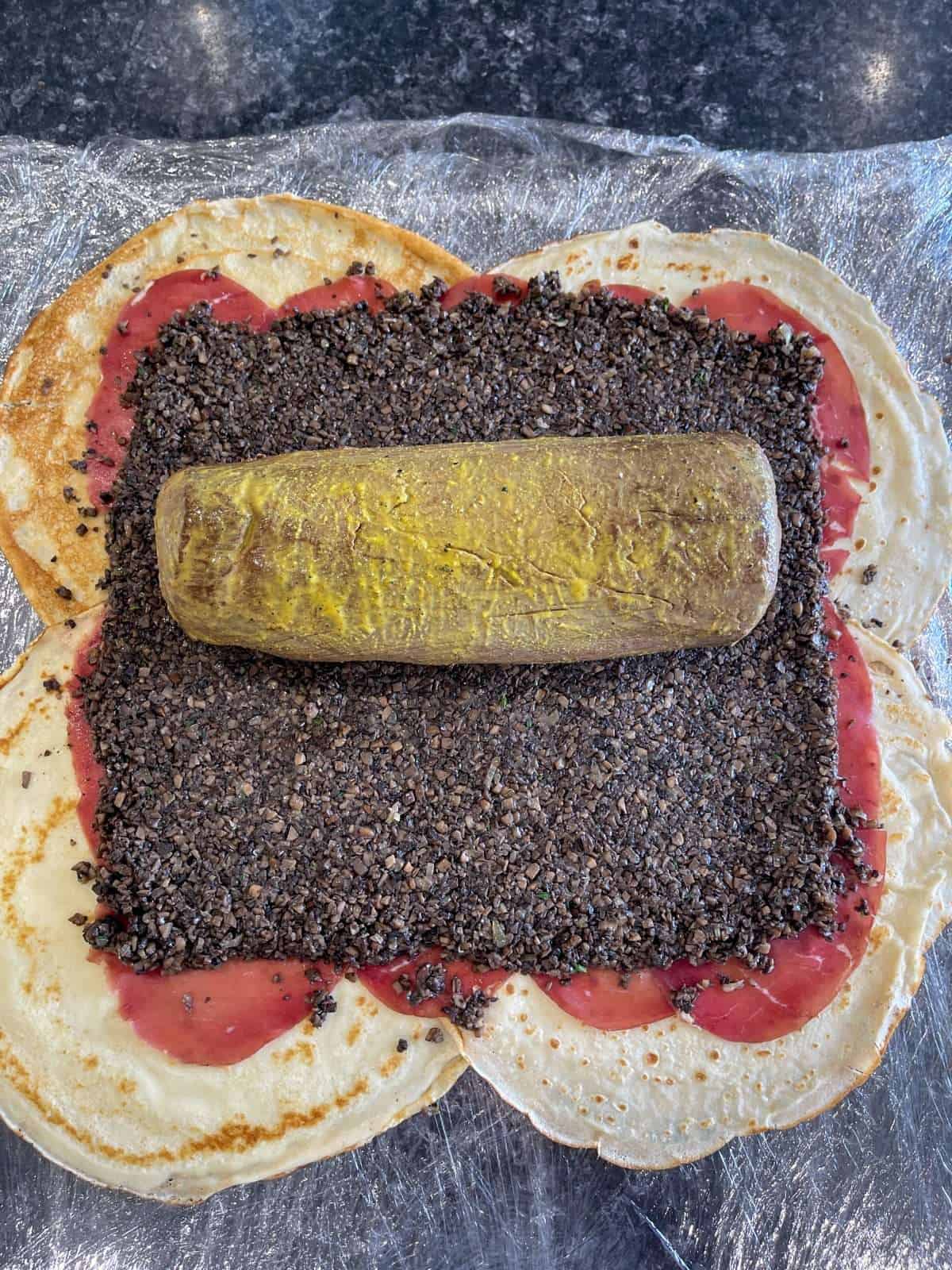
- Arrange four crêpes in the middle of the clingfilm. They should sit 2 crêpes wide & 2 tall and should overlap slightly, so that there aren’t any gaps.
- Top the crêpes with a single layer of thinly sliced bresaola, overlapping these slightly as well. The meat should almost completely cover the crêpes. You may need to cut a few slices of bresaola in half so that they fit.
- Spoon mushroom duxelles on top of the bresaola, spreading it out with a palette knife into an even layer that almost completely covers the meat.
- Remove the clingfilm from the fillet then lay it horizontally across the middle of the mushrooms, near the top edge.
- Using the clingfilm, carefully roll the crêpes/mushrooms around the beef. Make sure to tuck the edges of the crêpes underneath, to seal before rolling into a tight sausage & tying off each end. Chill this in the fridge overnight.
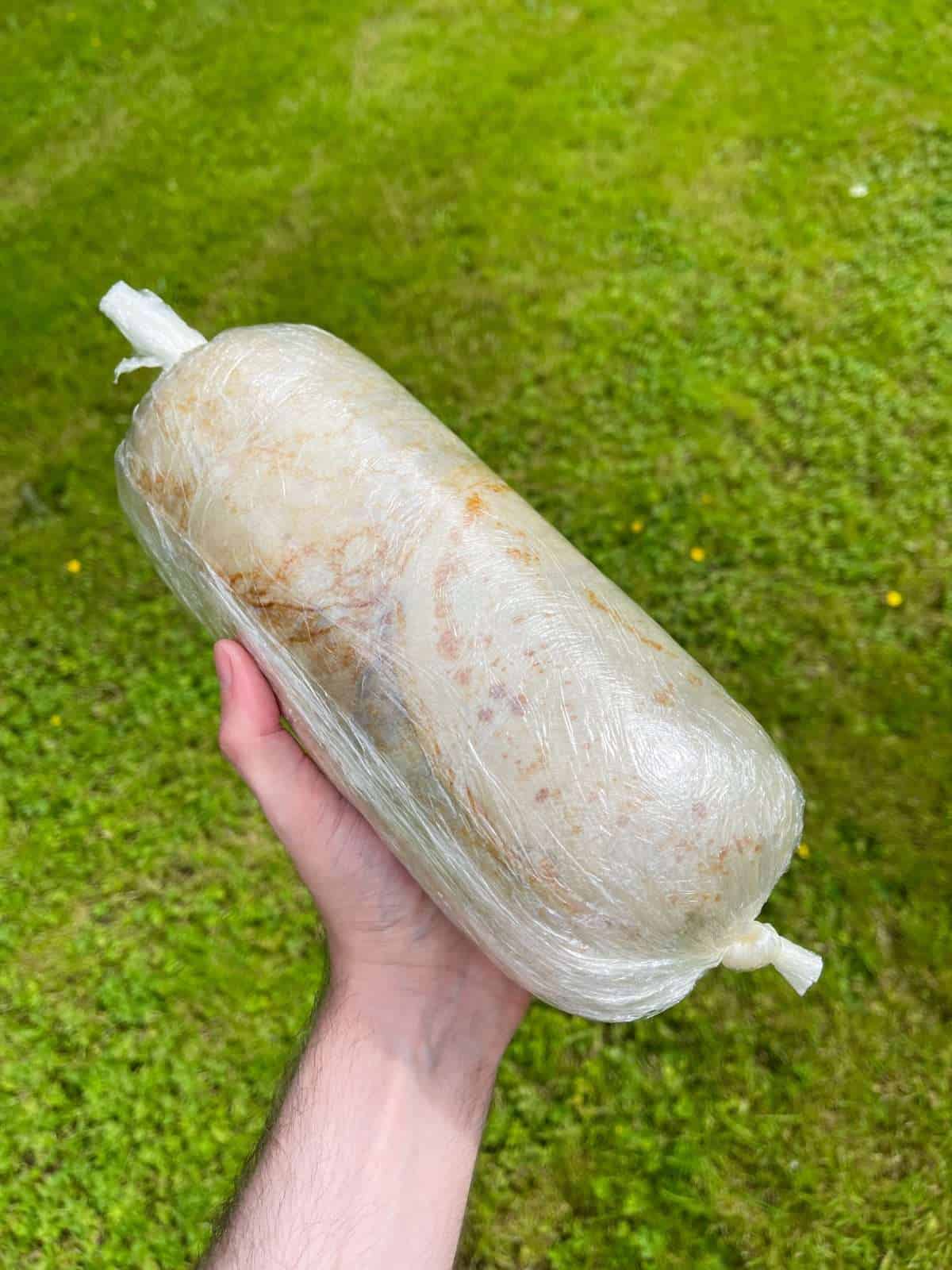
How To Wrap The Wellington In Pastry
- The next day, roll pastry out into a 40cm x 50cm rectangle (it should be 5mm thick). Brush the pastry lightly with egg wash then carefully remove the clingfilm from the filling then place horizontally in the middle of the pastry, near the top edge.
- Starting with the edge furthest away from you, tightly wrap the pastry around the filling. If necessary, trim some of the excess pastry from the bottom edge then roll the wellington over, to seal. The pastry should only overlap by a couple of centimetres.
- Gently flatten the excess pastry from each end with your hands then trim most of it off, leaving a few centimetres. Tuck the pastry underneath the wellington then place it seam side down, on a lined baking tray. Brush the wellington all over with a light layer of egg wash.
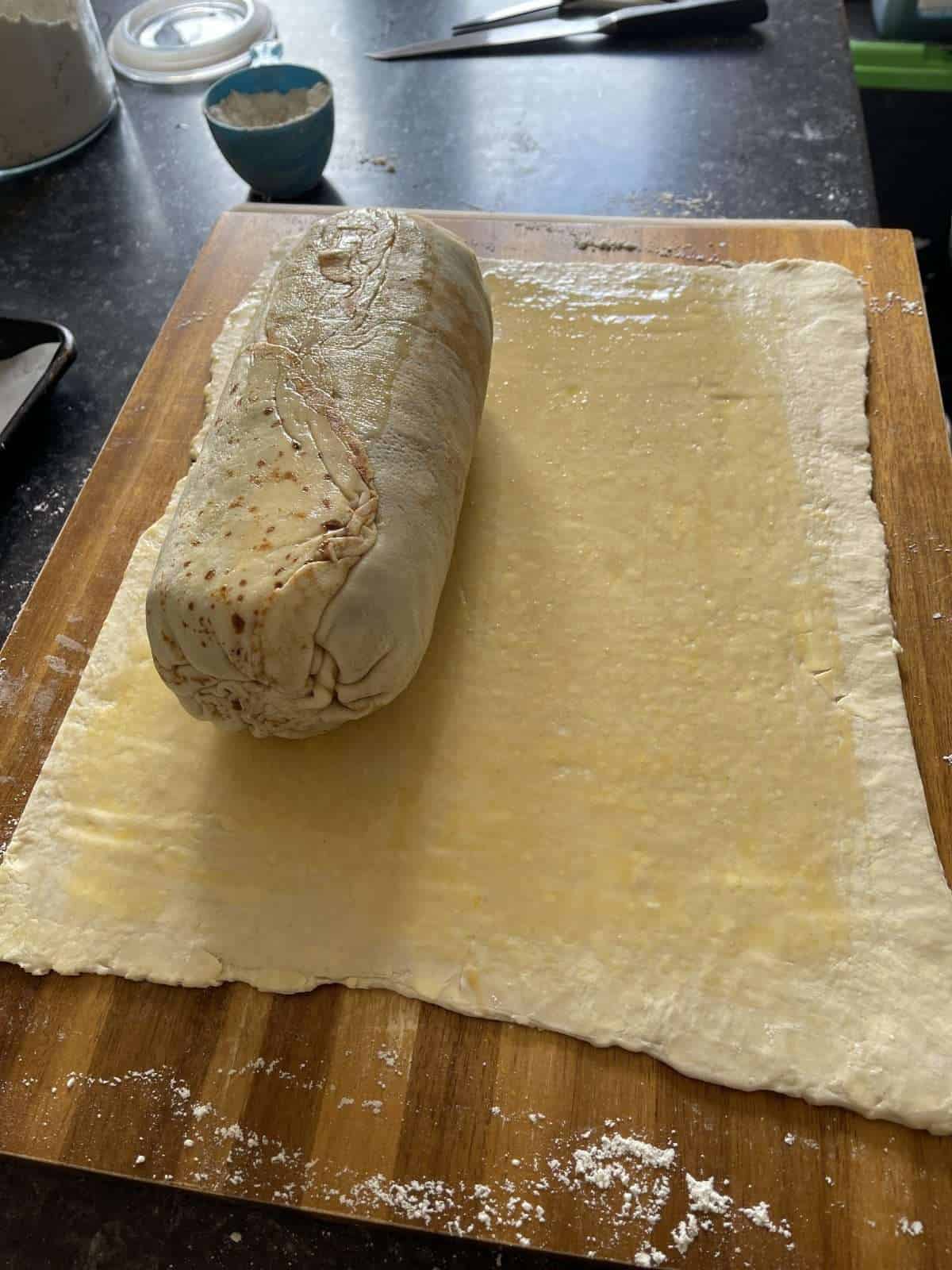
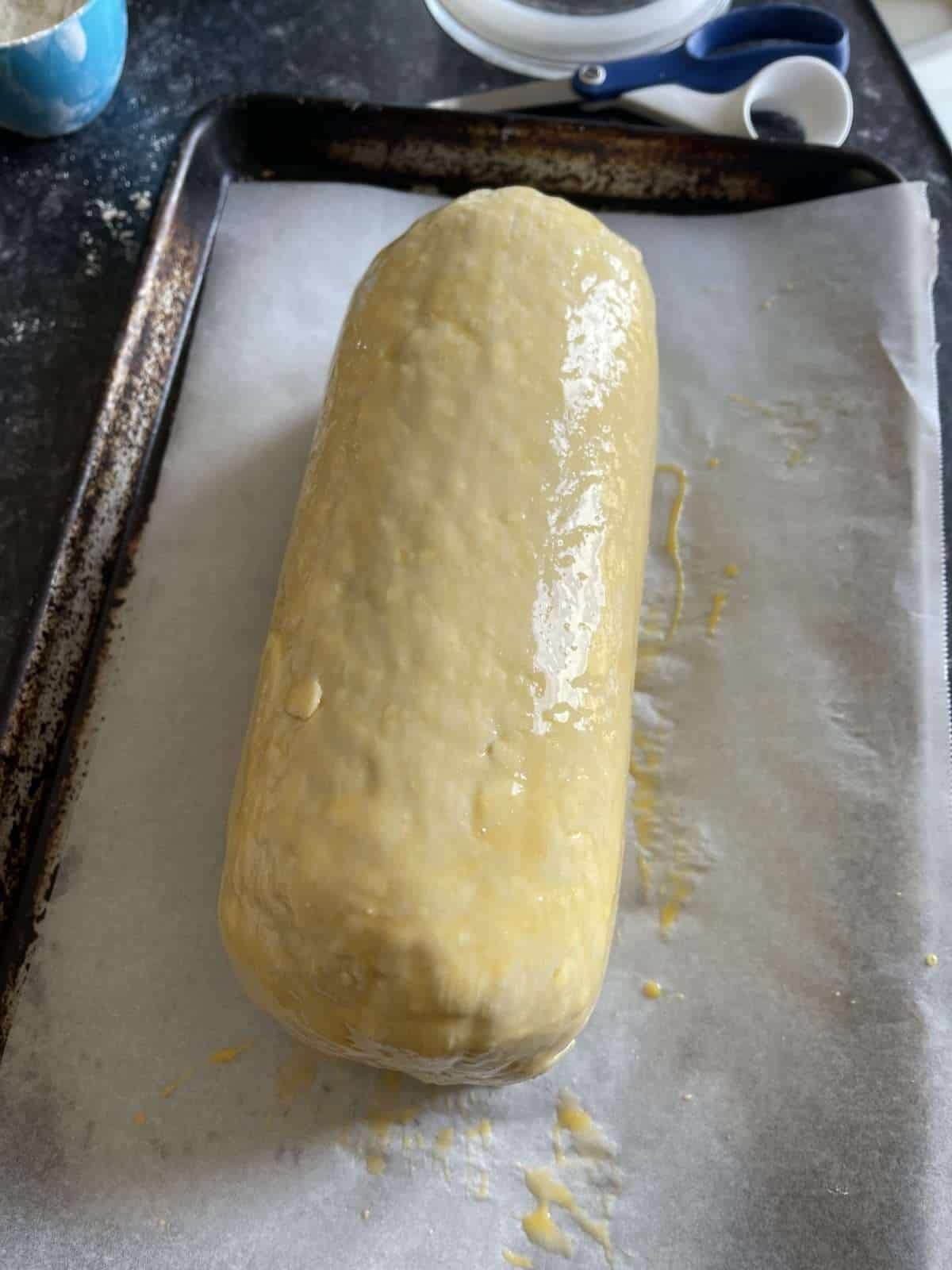
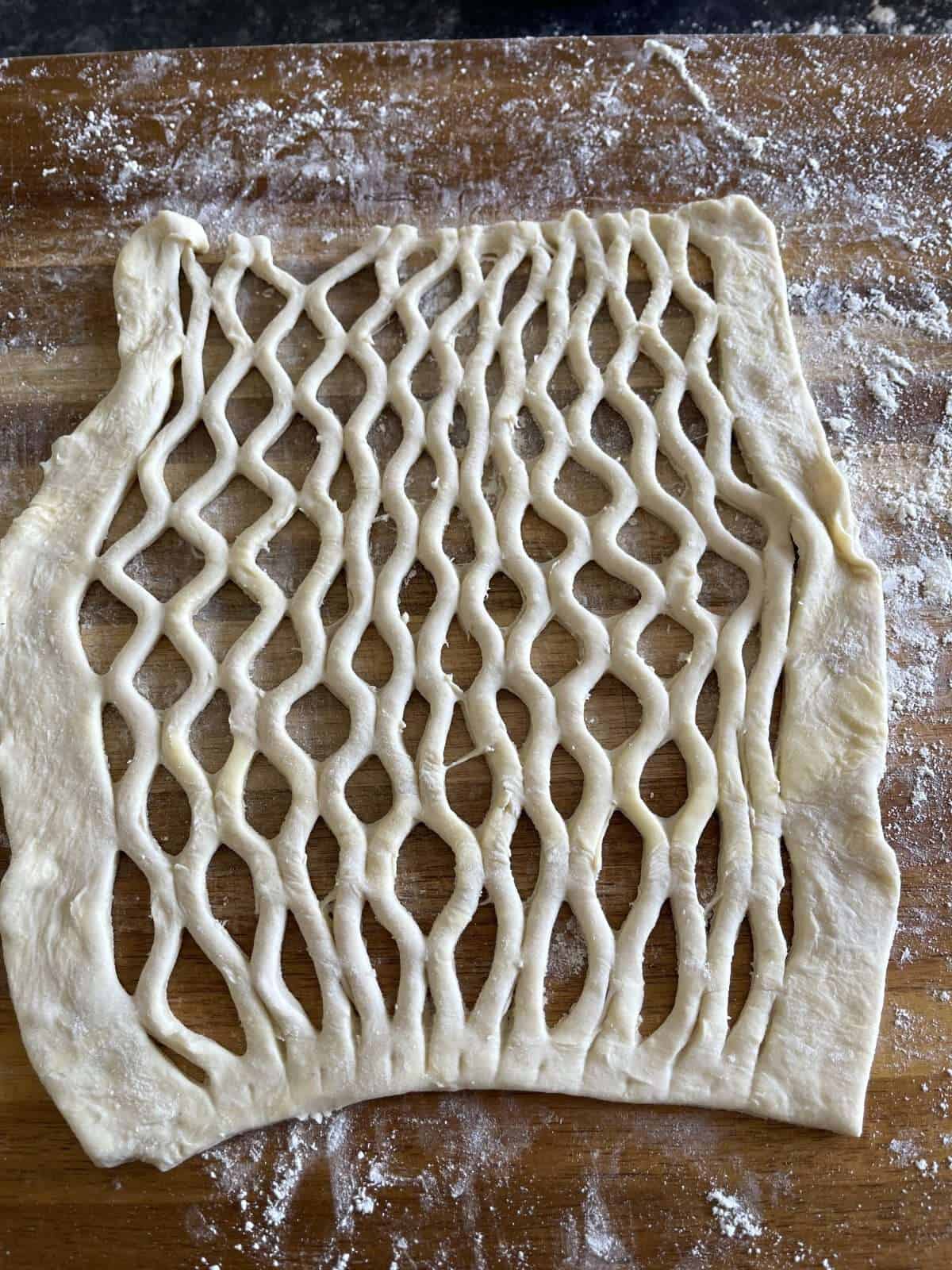
How To Make A Lattice
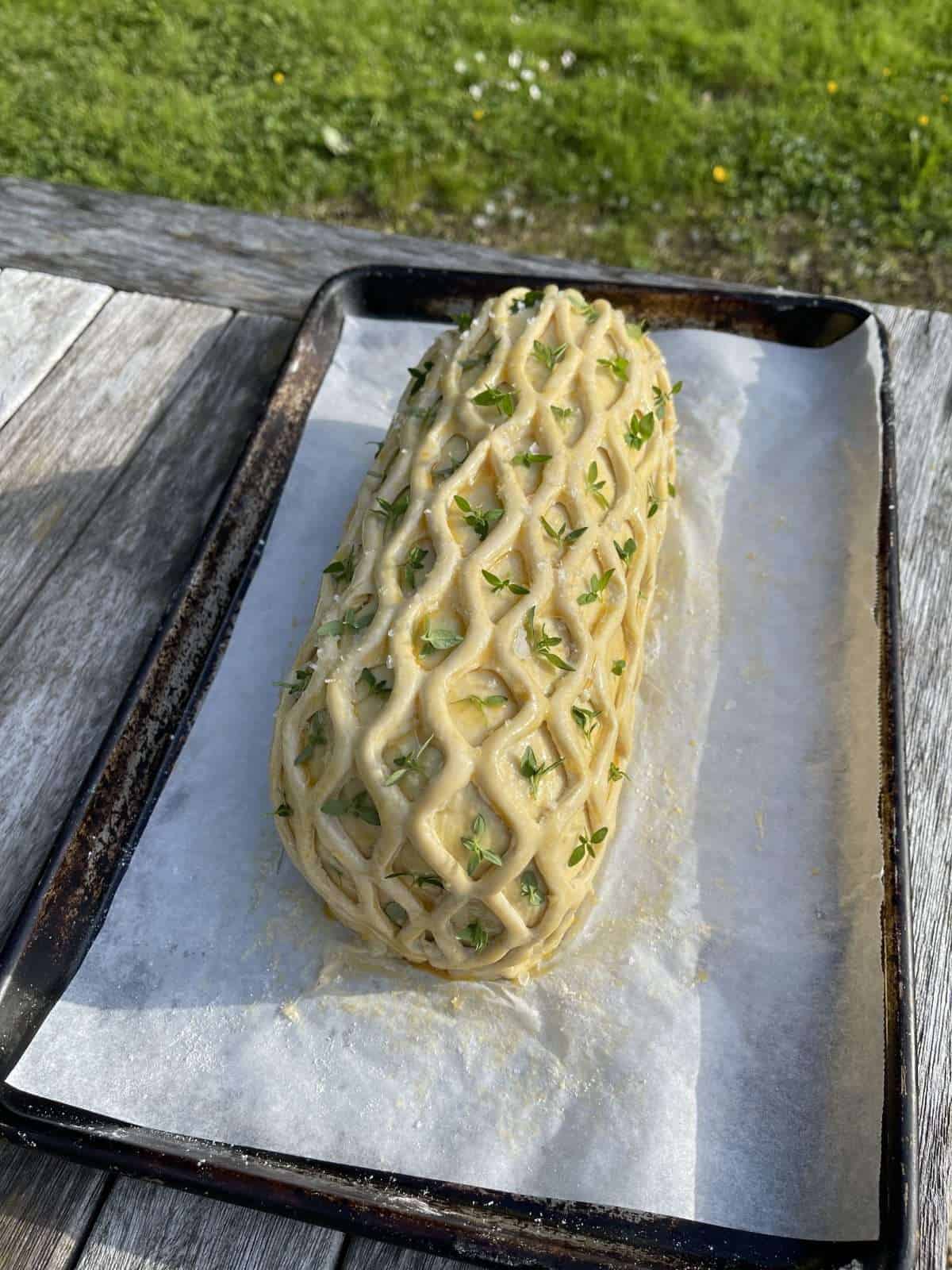
Now you don’t have to finish your wellington with a pastry lattice but it isn’t as difficult as it seems & adds a beautiful, professional finish.
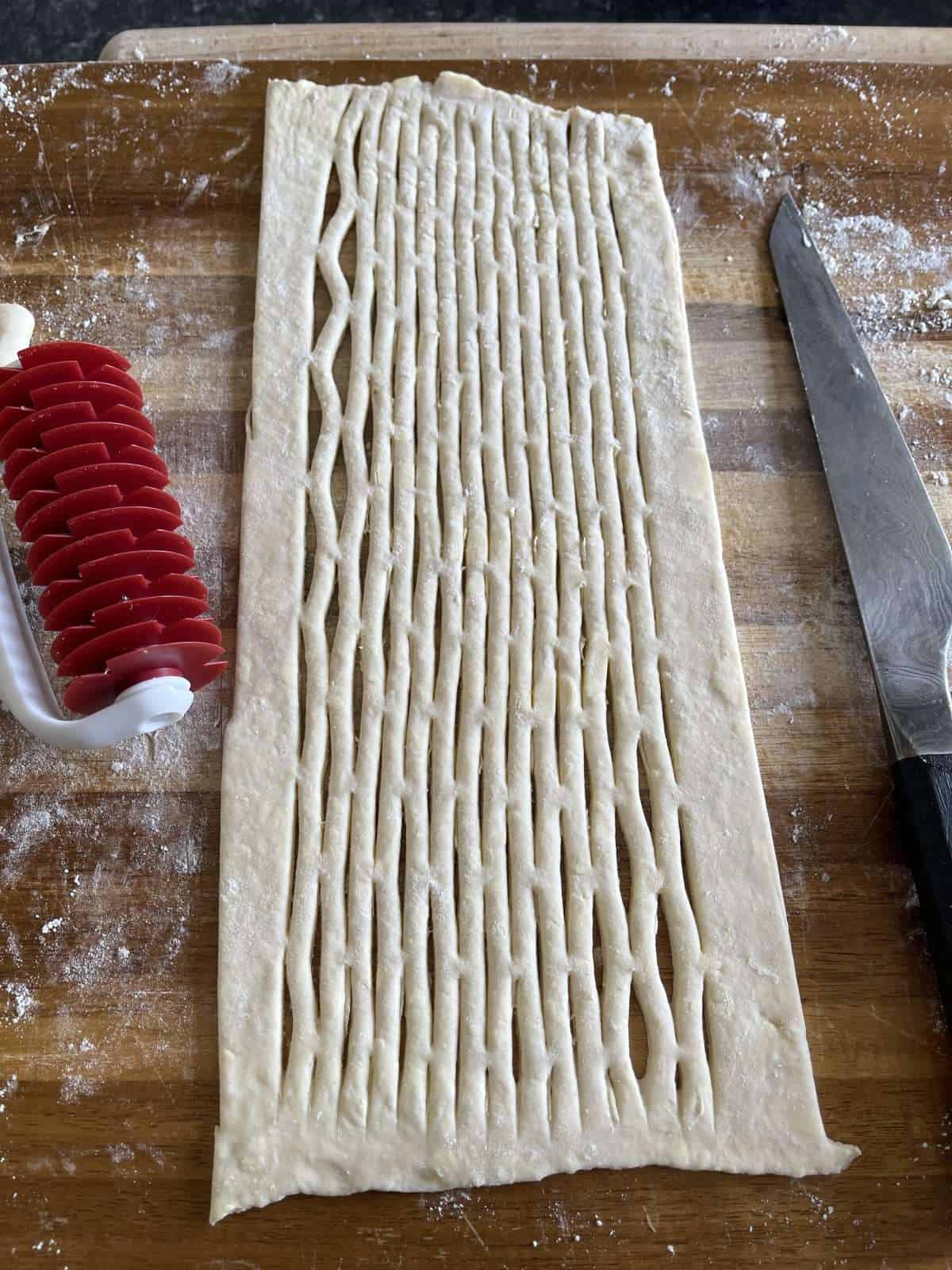
The key here is to use well chilled pastry & a lattice roller. Make sure to double check that the roller cut through the pastry properly before placing on top of the wellington. If you haven’t got a lattice roller, I would recommend lightly scoring the top of the wellington with the back of a knife instead.
- Roll 300 grams of pastry out into a 5mm thick rectangle. This should be slightly longer than your wellington & roughly 15 cm wide. Chill this in the fridge whilst you roll the filling in pastry.
- Once you’ve assembled & egg washed the wellington, take the pastry out of the fridge & run a lattice roller down its’ length.
- Use a sharp knife to cut through any pastry that wasn’t cut with the roller.
- Carefully stretch the lattice with your hands then lay over the top of the wellington.
- Gently stretch the lattice so that it completely covers the wellington then tuck the edges underneath, trimming any excess pastry off if necessary.
- Brush egg wash over the lattice then place a fresh thyme leaf in each gap. Season with sea salt then bake.
Beef Wellington 3 Day Schedule (Step By Step Plan)
There’s quite a lot of work involved in making a homemade beef wellington. Luckily we’re spreading the workload over 3 days! Here’s the schedule I follow when making a wellington at home. It keeps everything manageable & more organised.
Day 1
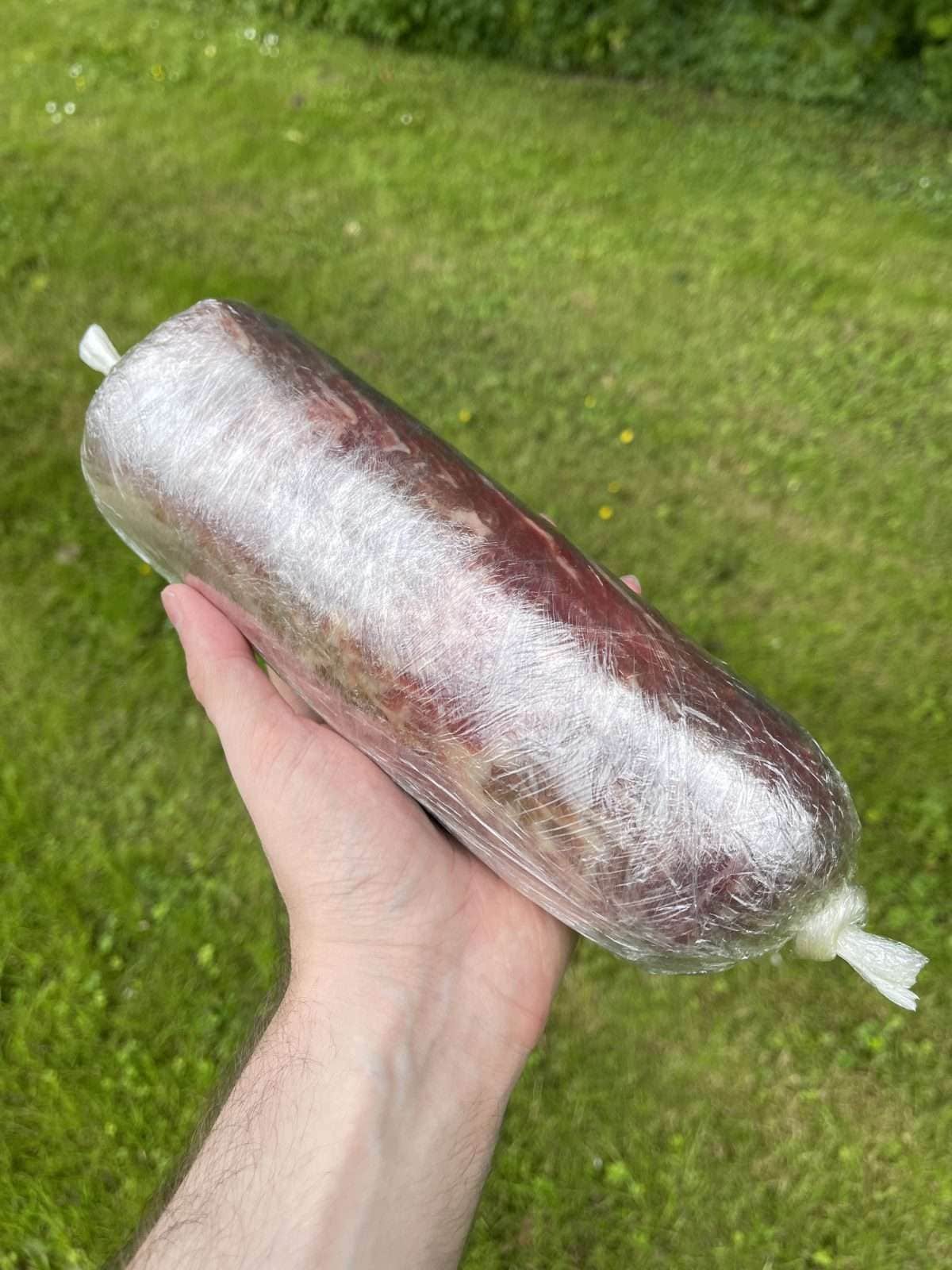
There’s not much to do on the first day. You’ll need to trim the beef, wrap it in clingfilm then chill in the fridge overnight, for the most uniform shape. This ensures that the beef cook evenly inside the wellington.
- Trim any sinew from the outside of the fillet.
- Roll the fillet in clingfilm for a more uniform shape.
- Chill in the fridge overnight.
Day 2
Most of our prep is done on the second day. If you’re making your own rough puff pastry, you’ll need to make it today as well.
- Searing The Beef
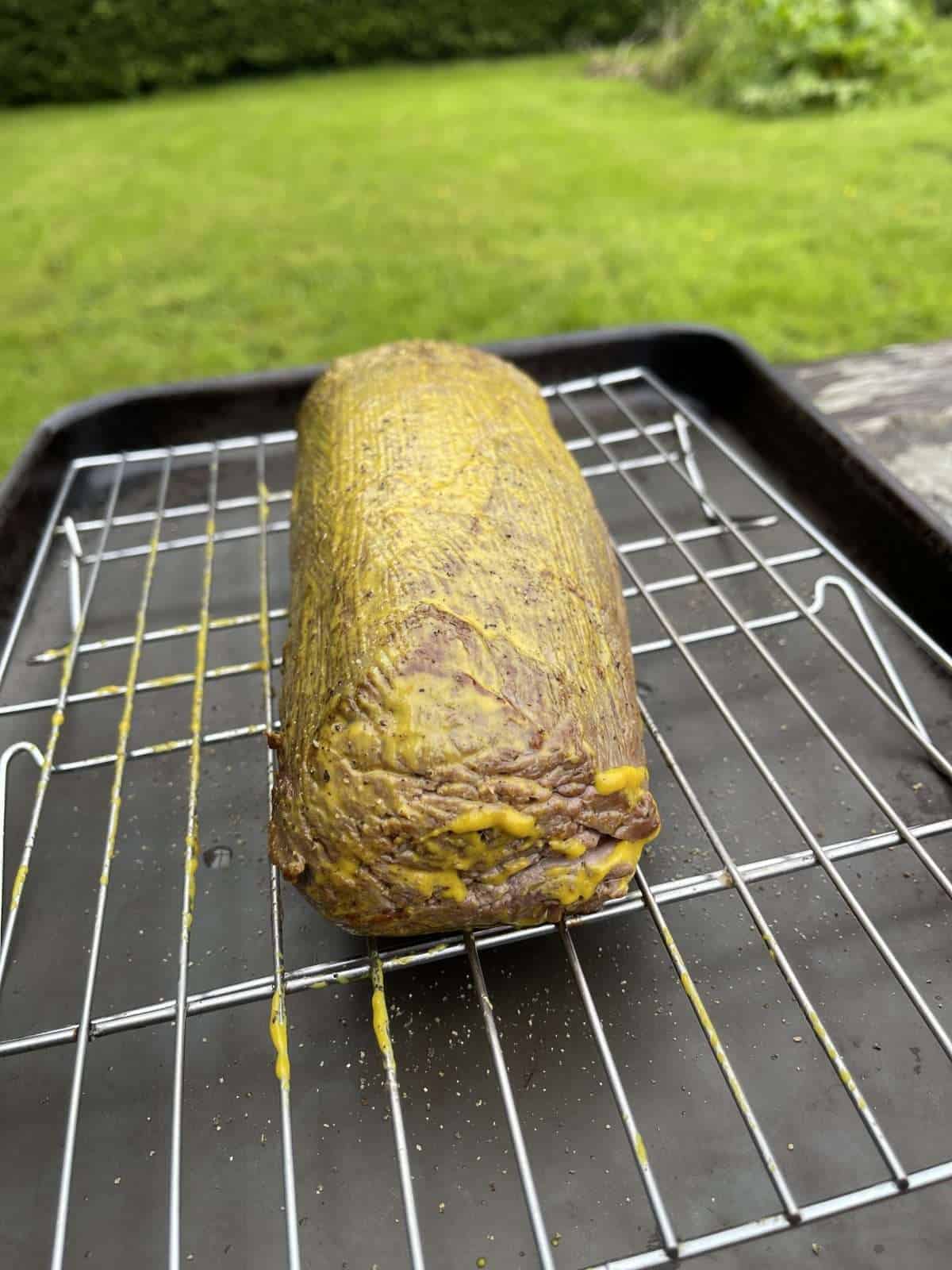
First, you need to sear the fillet of beef in a super hot pan, until browned well. Then brush the outside with English mustard, leave it to cool before rolling it in clingfilm again. This gets chilled in the fridge whilst you prep the rest of the components. - Mushroom Duxelles
Next, make your mushroom duxelles. To do this, cook finely diced shallots & grated garlic in butter, until soft (use the beef searing pan!) then transfer to a bowl.
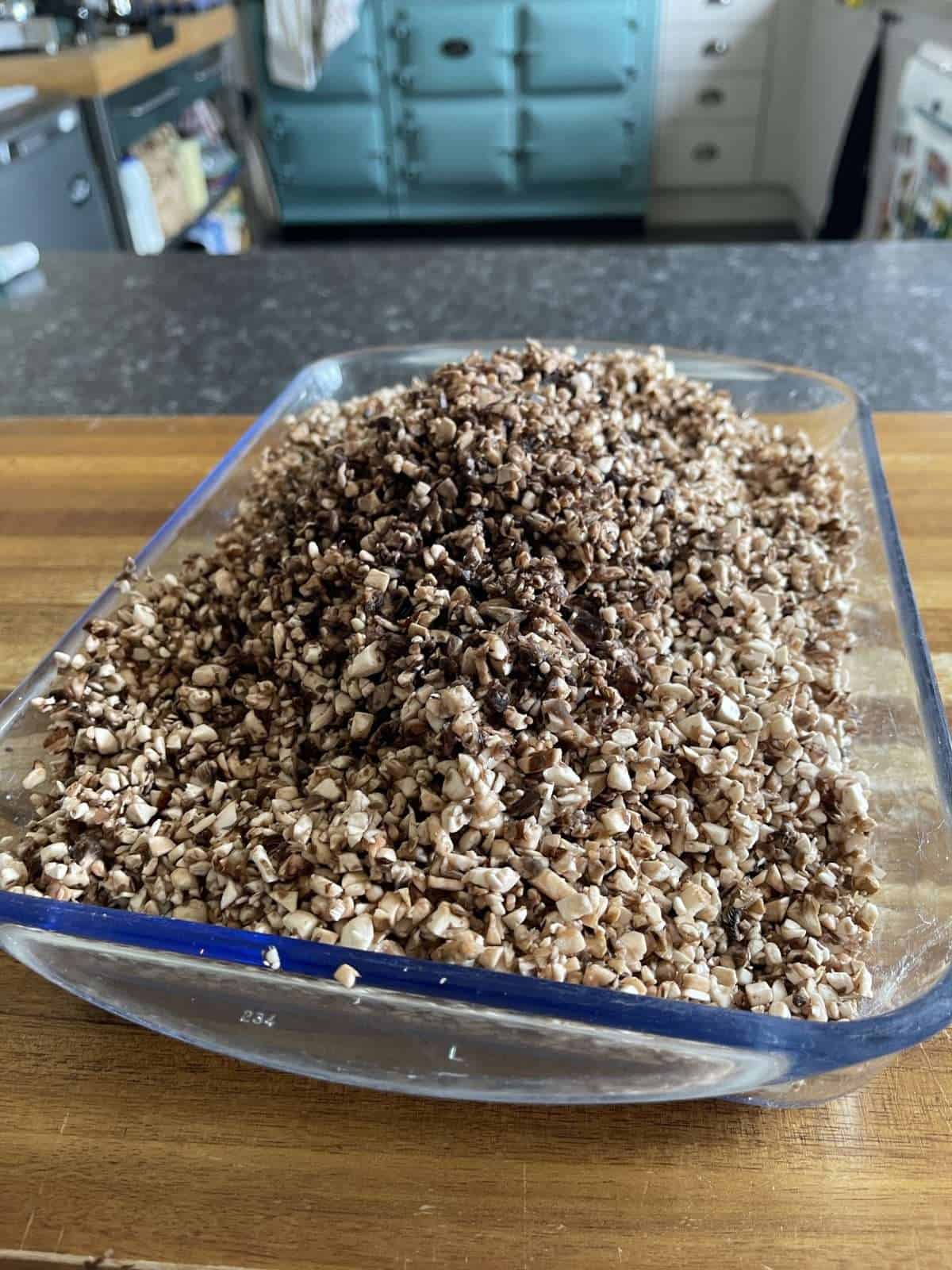
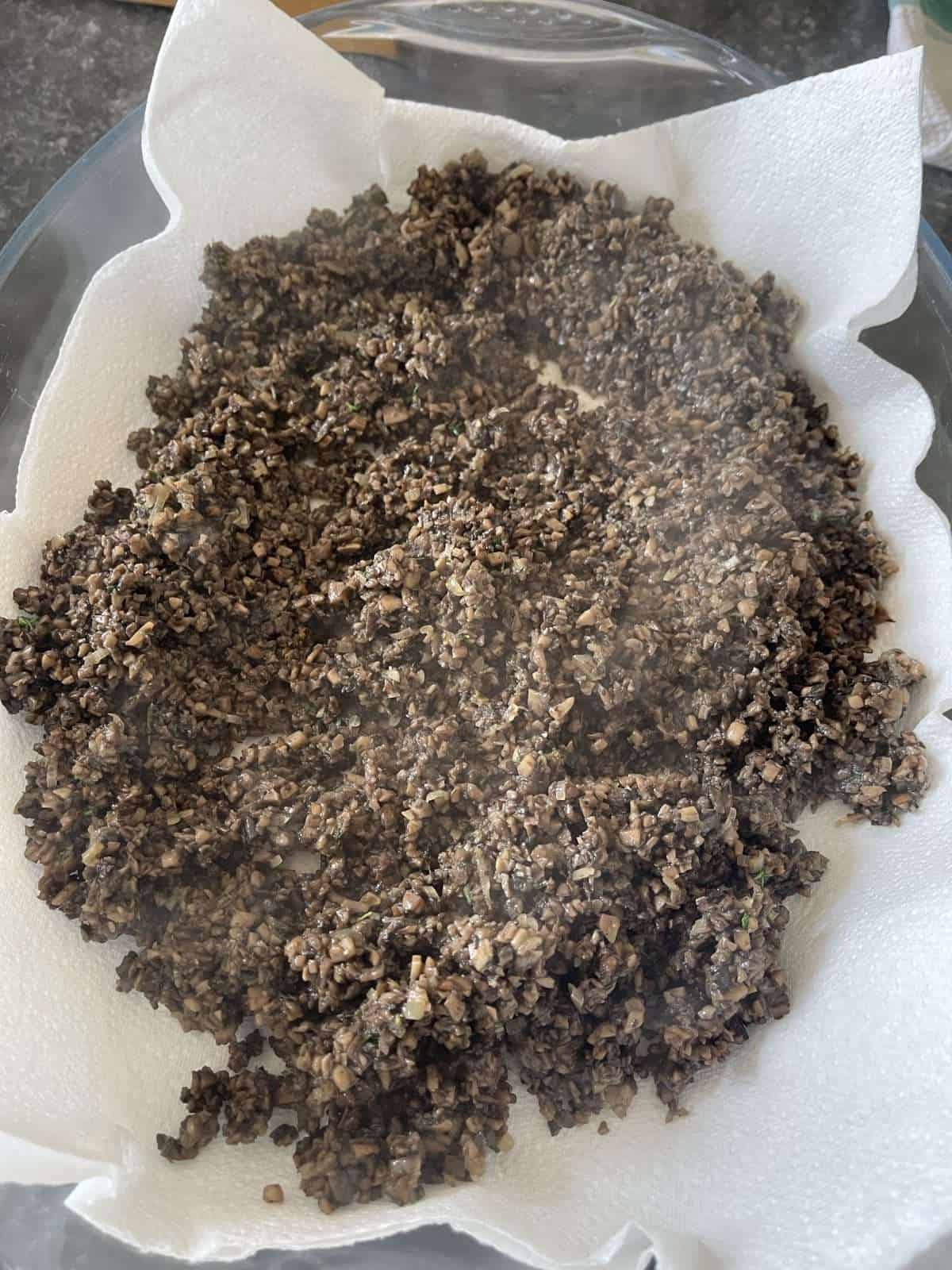
Next, set the pan over a high heat, add in a splash of veg oil, followed by finely chopped mushrooms & a good pinch of salt. This gets cooked until all of the moisture has evaporated then deglaze the pan with sherry & stir in the cooked shallots & some finely chopped thyme leaves. Season the mushrooms with pepper then leave the duxelles to cool completely, in a kitchen paper lined dish. - Crêpes
Whilst our mushrooms are cooling down, make the crêpes. These are made the classic way, with a batter made with flour, melted butter, egg, milk & pinch of salt. Then they’re cooked in a large frying pan, for 30 seconds on each side. You’ll need to let them cool completely before using. - Assembling The Filling
Once all of our components are cooled down, you can assemble the filling. There’s a full step by step guide above on how to do this!
Day 3
This is the final day & is when you will serve your wellington. Make sure to give yourself plenty of time to prep, cook & rest the beef. If you’re planning to serve at 5 pm (for example), I’d aim to get the beef wellington in the oven at around half past 3 in the afternoon.
- Roll Filling In Pastry
First, roll out our pastry into a 40cm x 50 cm rectangle then use this to wrap around the beef filling. There’s a full guide on how to do this above! - Lattice
Once the filling has been wrapped, brush the pastry all over with egg wash then top with a homemade pastry lattice (more on this in the section above). Give the lattice a light coating with egg wash then chill the wellington in the fridge, for 30 minutes. - Baking
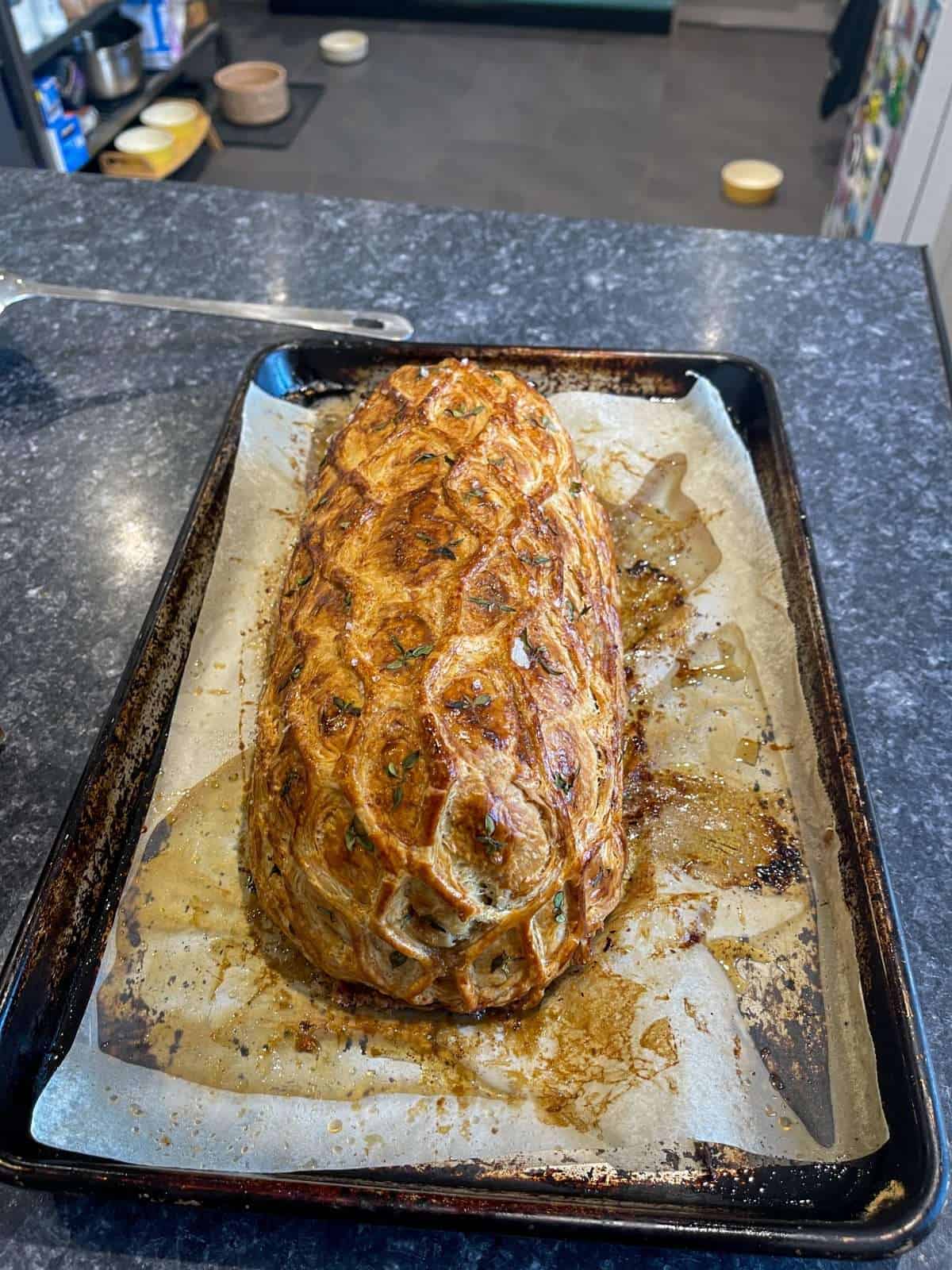
Next, add a thyme leaf into each gap in the lattice then sprinkle with sea salt. Bake the wellington at 210°c/410°f until the internal temperature in the middle of the beef reaches 42°c-46°c (110°f-115°f). This gives us a perfect medium rare once rested. The wellington will take roughly 40-50 minutes to cook. - Resting
Once cooked, let the beef rest for at least 30 minutes then cut it into thick slices & serve immediately. If you like, season the beef with sea salt & freshly cracked black pepper.
Beef Wellington Internal Temperature Guide
For the most tender, flavourful beef I’d highly recommend cooking your fillet medium rare. If you’d prefer you can cook your beef slightly more or less than this but you’ll need to keep in mind that the pastry will colour more the longer you cook it.
The temperature of the beef will continue to rise by a few degrees as it rests, which is why we take the wellington out of the oven when it’s a few degrees short of our target final temperature. As beef fillet is so lean & is surrounded by the rest of the wellington components, the internal temperature won’t be as high for each level of doneness compared to regular roast beef or steak.
| Beef Doneness | Internal Temperature (To Stop Cooking) | Internal Temperature (After Resting) |
|---|---|---|
| Rare | 42°c/108°f | 46°c/115°f |
| Medium Rare | 46°c/115°f | 52°c/125°f |
| Medium | 54°c/129°f | 60°c/140°f |
| Medium Well | 63°c/145°f | 65°c/150°f |
| Well Done | 68°c/154°f | 70°c/158°f |
What To Serve With Beef Wellington
Feel free to serve your beef wellington with whatever you like! I tend to serve mine with some roast potatoes, some sautéed greens & a really good homemade gravy. Bernaise sauce, fondant potatoes or dauphinoise potatoes would be some other good choices. This dish is rich & flavourful, so is best paired with light, simple sides to balance it out.
As beef wellington tends to be served at dinner parties, sharing, family style bowls of sides work best. This way, you can slice the wellington onto plates then everyone can help themselves to sides! We’ve got loads of sides to choose from over in our side dish recipe collection.

Beef Wellington Tips, Tricks & Troubleshooting
Tips & Tricks
- Don’t Rush – There’s quite a few different components to make for a beef wellington so it’s best to give yourself plenty of time to prep, cook & rest it.
- Use A Centre Cut Fillet – Ask your butcher for a centre cut beef fillet. This has a uniform thickness, which means that it will cook more evenly.
- Roll In Clingfilm – For uniform beef that is cooked evenly throughout, it’s best to roll it in clingfilm at each stage of the assembly process (before & after searing and once assembled).
- Make Your Own Pastry – Homemade puff pastry is best for beef wellington (in my opinion) & is easier to make & more robust than homemade puff pastry.
- Use A Food Probe – The best way to determine whether you’re beef is cooked, is to use a food probe to measure the internal temperature. I’d recommend a Thermapen.
- Cook At A High Temp – Pastry cooks best at a higher oven temperature & won’t turn soggy when cooked like this. Don’t worry about overcooking the beef, it has plenty of insulation.
- Rest Well – Make sure to rest your wellington for at least 30 minutes before serving. This lets the beef come up to temperature & reabsorb its’ juices.
- Slice With A Sharp Knife – Using a sharp serrated knife is key to getting the cleanest cuts.
Troubleshooting
Here are the most common issues people face & how to solve them, when making a beef wellington at home.
- The Fillet Is Over Cooked (Or Under Cooked)
Make sure to use digital food probe to check the internal temperature of the beef. There’s a full internal temperature guide in the post above. - When I Slice My Wellington, Juices Run Out
You need to let your wellington rest for longer. Make sure to let your wellington rest for at least 30 minutes before slicing. - The Pastry Is Soggy Underneath
This can happen if the duxelles contain too much moisture or if your oven isn’t hot enough. A trick to avoiding soggy pastry, is to preheat a tray in the oven then place the tray with the wellington on, on top. The heat from the preheated tray helps crisp the pastry up on the bottom of the wellington! - The Pastry Is Browning Too Quickly In The Oven
Your oven is too hot! Make sure to preheat your oven to the correct temperature, using a thermometer to double check the temperature. - The Pastry Is Tearing When I Assemble The Wellington
Your pastry is too cold, too warm or it has been rolled out too thin. To avoid this, make sure to chill the pastry in the fridge & don’t let it sit out for too long before using.
Frequently Asked Questions
Bresaola is a type of cured beef, made from meat from the cow’s hindquarter. Flavoured with herbs & spices, plus port/red wine, this cured meat has a meatier, more delicate flavour compared to prosciutto which is more typically used in a beef wellington.
For the best ever beef wellington, I’d recommend making your own rough puff pastry. Alternatively, a good quality shop bought puff pastry will work as well.
To accurately determine when your beef wellington is cooked, you’ll need to use a digital food probe. The internal temperature in the centre of the beef should be between 42°c-46°c (110°f-115°f) for medium rare. The temperature will rise slightly as the wellington rests, giving us perfectly cooked beef. Feel free to cook the beef more or less if you’d prefer though & there’s a full temperature guide included in this recipe.
The key to avoiding soggy pastry is to remove as much moisture as possible from the mushroom duxelles & to rest the cooked wellington for at least 30 minutes. We’re also using crêpes in our wellington’s filling, which acts as another moisture barrier between the meat and pastry.
Ideally, beef wellington should rest for at least 30 minutes before it is sliced & served. This gives the meat enough time to finish cooking (the temperature will rise slightly as it rests) & to reabsorb the juices. Slice your wellington too soon & all the juices will run out, making the pastry soggy.
Yes, beef wellington can be made ahead of time & is actually designed to be prepared in advance. You can prepare the filling & assemble the wellington a day or two before baking then chill in the fridge until you’re ready to bake.
Leftover beef wellington needs to be stored in the fridge & is best eaten within 2 days, either hot or cold. The best way to reheat leftover beef wellington is by cutting the wellington into slices then baking at 180°c/356°f until hot. Keep in mind that the beef won’t be as pink when you reheat it. To keep the beef moist, I like to reheat my leftover wellington in a dish, with a splash of gravy.
How To Cook Beef Wellington In An Aga
With all of my recipes, I include cooking instructions for conventional ovens, fan ovens & also Agas. Here’s how to cook this recipe in an Aga…
To sear the beef, use the boiling plate. Cook the shallots (for the duxelles) on the simmering plate then move to the boiling plate to cook the mushrooms. Cook the crêpes using the boiling plate as well. Bake the wellington in the roasting oven, on a grid shelf placed on the floor. If the pastry needs more colour towards the end of the cook, move the tray up to the bottom set of runners.
More Restaurant Quality Dishes To Try
- Smoked Beef Short Rib, Guinness & Bone Marrow Pie
- Slow Roasted Prime Rib (Reverse Seared)
- Black Garlic Roasted Picanha (Beef Rump Cap)
- Black Garlic Pork Belly Porchetta
- Guinness & Bone Marrow Gravy
- Dauphinoise Potatoes
Watch How To Make Beef Wellington At Home
If you have enjoyed this beef Wellington recipe, it would mean a lot if you could leave a review & rating. And if you’d like to stay up to date with future recipes, follow us on Instagram & TikTok or subscribe to our newsletter!

The Ultimate Beef Wellington
Equipment
- Lattice Cutter
- Digital Food Probe
- Large Baking Tray
- Large Pan
- Microplane/Grater
- 10" Frying Pan
- Wire Cooling Rack
- Palette Knife
- Rolling Pin
Ingredients
Beef
- 1 kg Centre Cut Beef Fillet (See Notes)
- 2 tbsp Vegetable Oil
- 2 tsp English Mustard
Mushroom Duxelles
- 3 Shallots Peeled
- 2 Garlic Cloves Peeled
- 1 kg Mushrooms (See Notes)
- 20 g Unsalted Butter
- 1 tbsp Vegetable Oil
- 100 ml Sherry
- 1 tsp Finely Chopped Thyme Leaves
Crêpes
- 15 g Unsalted Butter
- 65 g Plain Flour
- 140 g Whole Milk
- 1 Large Egg
To Assemble
- 100 g Bresaola (Roughly 12 Large Slices)
- 900 g Rough Puff Pastry (See Notes)
- Thyme Leaves
Egg Wash
- 3 Egg Yolks
- 3 tsp Cold Water
- A Pinch Of Table Salt
Instructions
Prepping The Beef
- First, use a sharp knife to trim off any sinew from the outside of the beef fillet.
- Next, lay a double layer of clingfilm down on your workbench then place the beef on top. Tightly roll up the beef in the clingfilm, then tie off each end. Chill in the fridge overnight.The clingfilm should be slightly longer than the beef, so that we can tie off each end.
- The next day, set a large pan over a high heat, add in 2 tbsp of vegetable oil then leave to get smoking hot.
- In the meantime, unwrap the beef, pat dry with kitchen paper then season the outside generously with table salt.
- Once the oil is hot, add in the beef then sear well on all sides, making sure to flip the beef every 5-10 seconds. We're not cooking the beef at this point, only searing the outside. Make sure to get the oil smoking hot, for the best sear. Once the beef is seared, set the pan to one side, we'll be using this to cook the duxelles in.
- Transfer the beef to a wire cooling rack, set over a tray then brush all over with the English mustard. Season with freshly cracked black pepper, leave to cool then wrap in another double layer of clingfilm & chill in the fridge.
Mushroom Duxelles
- Finely dice the shallots & grate the garlic then place into a bowl & set aside.
- Next, chop up the mushrooms by hand, as fine as possible, placing them into another bowl as you chop them.You could also use a food processor to chop up the mushrooms, in batches. But for the best texture, it's worth taking the time to do them by hand.
- Set the pan that you seared the beef in over a low heat then add in the butter. Leave to melt then add in the shallots & garlic. Cook for 5-10 minutes, until soft then transfer to a bowl.
- Increase the heat up to high, add in the tbsp of veg oil then leave for a minute or two, to get hot.
- Add the mushrooms to the pan, along with a good pinch of salt then cook, stirring regularly until all of the moisture from the mushrooms has evaporated. This will take around 10 minutes.
- Deglaze the pan with the sherry, letting it reduce completely then stir in the cooked shallots & the chopped thyme leaves. Season with freshly cracked black pepper then transfer to dish lined with kitchen paper & leave to cool completely.
Crêpes
- Melt the butter (in a microwave or a pan) then add into a mixing bowl along with the flour, milk & egg. Season with a pinch of a salt then whisk to combine. Pass the batter into another bowl, through a sieve.
- Place a 10" frying pan/skillet over a medium heat then once hot, grease with a small amount of butter or oil.
- Add a small ladle full (roughly 4 tbsp/60 ml) of batter into the pan then tilt so that the batter completely covers the bottom, in a thin, even layer.
- Cook the crêpe for 30-40 seconds, until the bottom is lightly browned & the top looks dry then flip over with a spatula & cook for another 30 seconds.
- Transfer the cooked crêpe to a plate then repeat the cooking process with the remaining batter. Once all of the batter is cooked, let the crêpes cool completely.We need to make 4 large crêpes but they're should be enough batter to make a couple extra.
Assembling The Filling
- Lay a double layer of clingfilm down on your work surface & smooth out with a tea towel. Make sure to give yourself enough room to tie off each end. I'd recommend 3 sheets of clingfilm wide.
- Next, place 4 crêpes in the middle of the clingfilm, arranging them 2×2 & overlapping them slightly (there shouldn't be any gaps!).
- Top the crêpes with a single layer of bresaola slices, overlapping these slightly as well. The meat should almost completely cover the crêpes. You may need to cut a few slices of bresaola in half so that they fit.
- Spoon the duxelles on top of the bresaola then use a palette knife to spread them into an even layer that completely covers the meat.
- Unwrap the beef then place horizontally, near the top edge of the duxelles (the side furthest away from you).
- Using the clingfilm, carefully roll the crêpes/mushrooms around the beef. Make sure to tuck the edges of the crêpes underneath, to seal before rolling into a tight sausage & tying off each end. Chill this in the fridge overnight.
Assembling The Wellington
- Take a third (300 grams) of the pastry & roll out on a lightly floured surface, into a 5mm thick rectangle then place onto a tray & chill in the fridge. We'll be using this pastry for the lattice, so it should be slightly longer than the wellington & around 15 cm wide.
- Make the egg wash by whisking together the yolks, water & salt then set aside.
- Next, roll the remaining pastry out into a 40cm x 50cm rectangle, that is also 5mm thick.
- Trim the edges, to neaten up if necessary, dust off any flour then brush the entire top of the pastry with a light layer of egg wash.
- Carefully remove the clingfilm from the filling then place horizontally in the middle of the pastry, near the top edge.
- Starting with the edge furthest away from you, tightly wrap the pastry around the filling. If necessary, trim some of the excess pastry from the bottom edge then roll the wellington over, to seal. The pastry should only overlap by a couple of centimetres.
- Gently flatten the excess pastry from each end with your hands then trim most of it off, leaving a few centimetres. Tuck the pastry underneath each end then place the wellington seam side down, on a lined baking tray. Brush the wellington all over with a light layer of egg wash.
- Next, take the chilled piece of pastry out of the fridge & place onto your work surface. Run a lattice roller down the length of the pastry (down the middle) then use a sharp knife to open up any of the cuts that weren't made properly.
- Carefully stretch out the lattice with your hands then confidently lay over the top of wellington. Gently stretch the lattice so that it completely covers the wellington then tuck the edges underneath, trimming any excess pastry off if necessary.
- Brush the wellington all over, with another light layer of egg wash then chill in the fridge for 30 minutes. In the meantime, preheat an oven to 210°c/190°c fan (410°f/374°f). Place a large baking tray in the oven at the same time.
Cooking
- Brush the wellington all over with a final (light) layer of egg wash, place a fresh thyme leaf inside each of the gaps made by the lattice then sprinkle with sea salt.
- Place the tray with the wellington on, on top of the tray in the oven then bake until the centre of the beef reaches an internal temperature of 42°c-46°c (110°f-115°f). This will take around 40-50 minutes but check after 30. This is for medium rare beef, so feel free to cook it more if you'd prefer. I'd recommend turning the tray after 30 minutes, so that the pastry browns evenly. Baking the wellington on a hot tray helps crisp the pastry up on the bottom. Don't worry if you haven't got a tray big enough though, you can bake the wellington in the oven & it will still turn out great.
- Once cooked, let the wellington rest for 30 minutes then transfer to a chopping board. Use a sharp knife to cut into thick slices then serve, seasoning each slice with sea salt & freshly cracked black pepper.
Salt Butter Smoke Magazine
Food that’s made for sharing.
The Christmas 2026 issue features 30 festive recipes, Christmas cooking guides, beautiful food photography and features on everything from the perfect cheeseboard to the art of trifle.
Discover the Christmas Issue →Notes
Enjoying This Recipe?
The Prep List is my free weekly newsletter with seasonal recipes, kitchen notes and behind-the-scenes from my kitchen. Add Salt Butter Smoke as a Google Preferred Source to see more of my recipes in Search.


I’ve always thought Beef Wellington was impossible to make, but your breakdown gives me confidence to finally try. I posted something similar on my site, though not nearly as detailed as this.