Pain Aux Raisin Danish Pastries
Flaky, buttery pain aux raisins made with homemade Danish pastry, rich vanilla custard, and juicy raisins. A step-by-step bakery-style recipe that’s easy to follow.

These bakery-style pain aux raisins are incredibly flaky, buttery and packed with silky vanilla custard and plump, juicy raisins. And they are finished with a glossy apricot glaze, just like in a French bakery.
If you’ve ever wanted to make proper Danish pastries at home, this step-by-step recipe will show you exactly how to get perfectly laminated dough, defined layers, and that classic artisan swirl. This includes how to make properly hand laminated Danish dough & an easy vanilla pastry cream filling.
This one’s a slightly more involved bake, but I’ll walk you through every step so that it works every time. And once you’ve made them once, you’ll want them far more often than just a weekend treat. You can eat these pastries warm for breakfast, as a snack at lunchtime or for a treat at the weekend.
For more bakery quality recipes, take a look at our ever growing collection of baking recipes! Here you’ll find cakes, cookies, brownies, pastries, homemade bread, sourdough & lots more.
Why You’ll Love This Recipe
Flaky, buttery Danish pastries with a rich custard centre & plenty of juicy raisins, made properly from scratch. What’s not to like?!
- Bakery Quality Pastries
Skip the trip to a bakery & make Danishes at home! It’s a lot easier than it looks & are sure to impress. - Easy To Follow, Step By Step Method
Each step is broken down into an easy to follow method with exactly what to look out for. This eliminates any guesswork and you can make pain aux raisin with confidence. - Perfect Balance Of Textures
Crisp, flaky pastry, creamy custard & plump, juicy raisins work great together! - Properly Laminated Dough
Our homemade Danish pastry recipe shows you how to properly laminate the dough by hand. - Can Be Made Ahead Of Time
Danish pastry dough is designed to be made ahead of time, as it slowly proves in the fridge. This makes for a more relaxed bake!
Pain Aux Raisin Components
These pastries are made with 4 simple components. Each one plays a key role in getting the best flavour, texture & that classic bakery style finish.
- Homemade Danish Pastry
This is the foundation of this recipe, giving you those crisp, buttery layers. You’ll need a batch of my Danish pastry dough, that we prepare the day before to allow for proper lamination and flavour development. Once it’s made, the rest of the process is straightforward. Don’t worry, it’s not as hard as it sounds & my recipe is super easy to follow! - Vanilla Pastry Cream
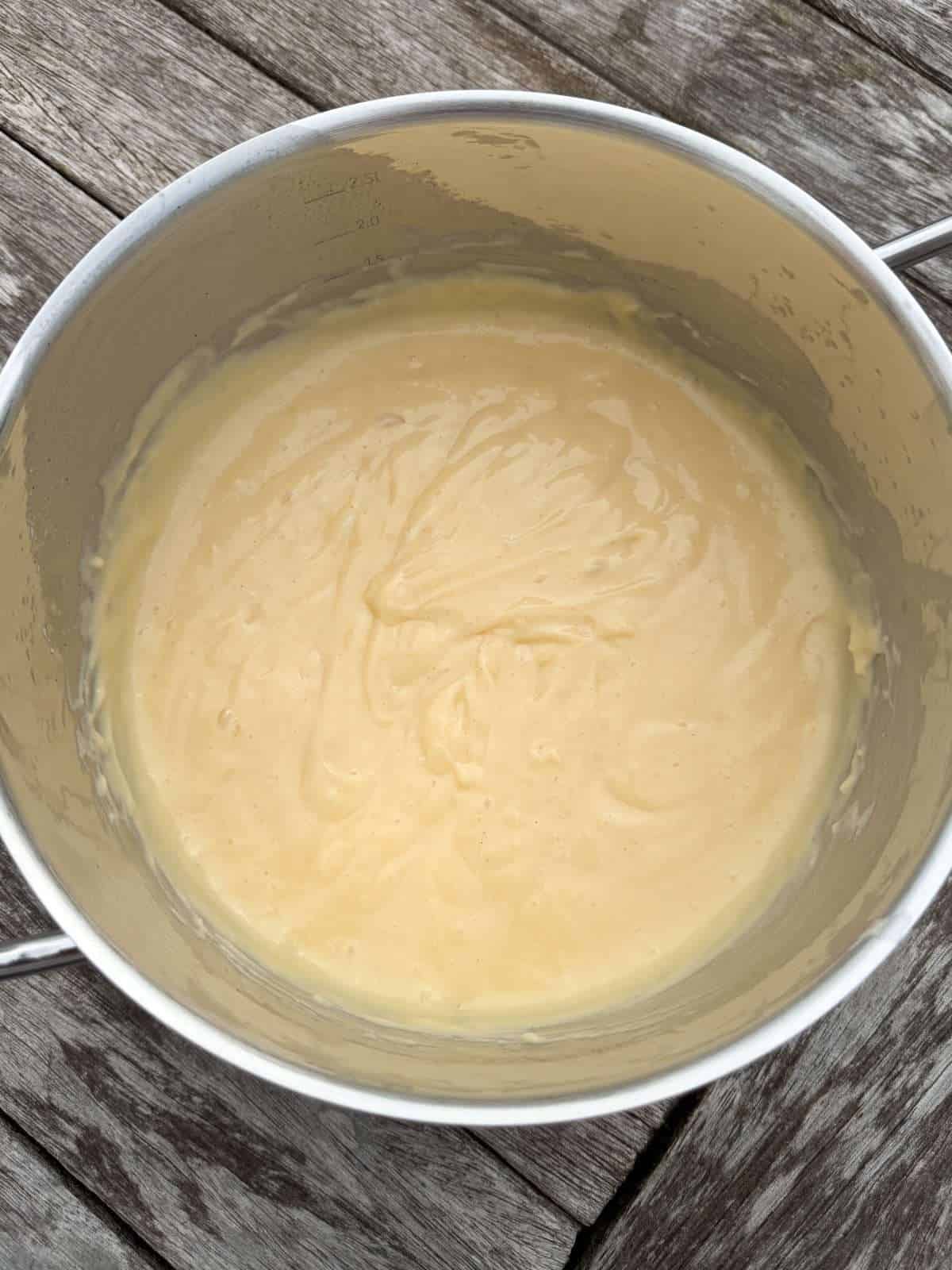
Pastry cream is a thick, silky smooth custard that is the classic filling in a pain aux raisin. This is made like a regular custard but is thickened with cornflour so that it doesn’t run out of the pastries as they bake. I like to make this the day before making the pastries so that is has plenty of time to set in the fridge. - Soaked Raisins
Plump, juicy raisins are essential here. Soaking them in hot water for about an hour rehydrates them, giving you a softer texture and better flavour throughout the filling. I like to use a mix of regular and golden raisins for balance but just regular raisins will work as well. - Glaze
We’re using apricot jam to glaze these Danish pastries. To give the jam a brush able consistency, we mix it with a splash of warm water. This style of glaze adds sweetness to the pastries and a sticky, glossy finish.

How To Make Pain Aux Raisin
Making pain aux raisins is all about the prep! Once the pastry, custard & raisins are ready, it’s just a case of assembling, proving, baking & glazing them.
- Roll Out Pastry
First, roll your Danish pastry out on a lightly floured surface, into a rectangle that measures 30×40 cm & is roughly 5mm thick. Trim the edges if needed, to keep it neat. This gives the pastries more even, professional looking swirls. - Add Fillings
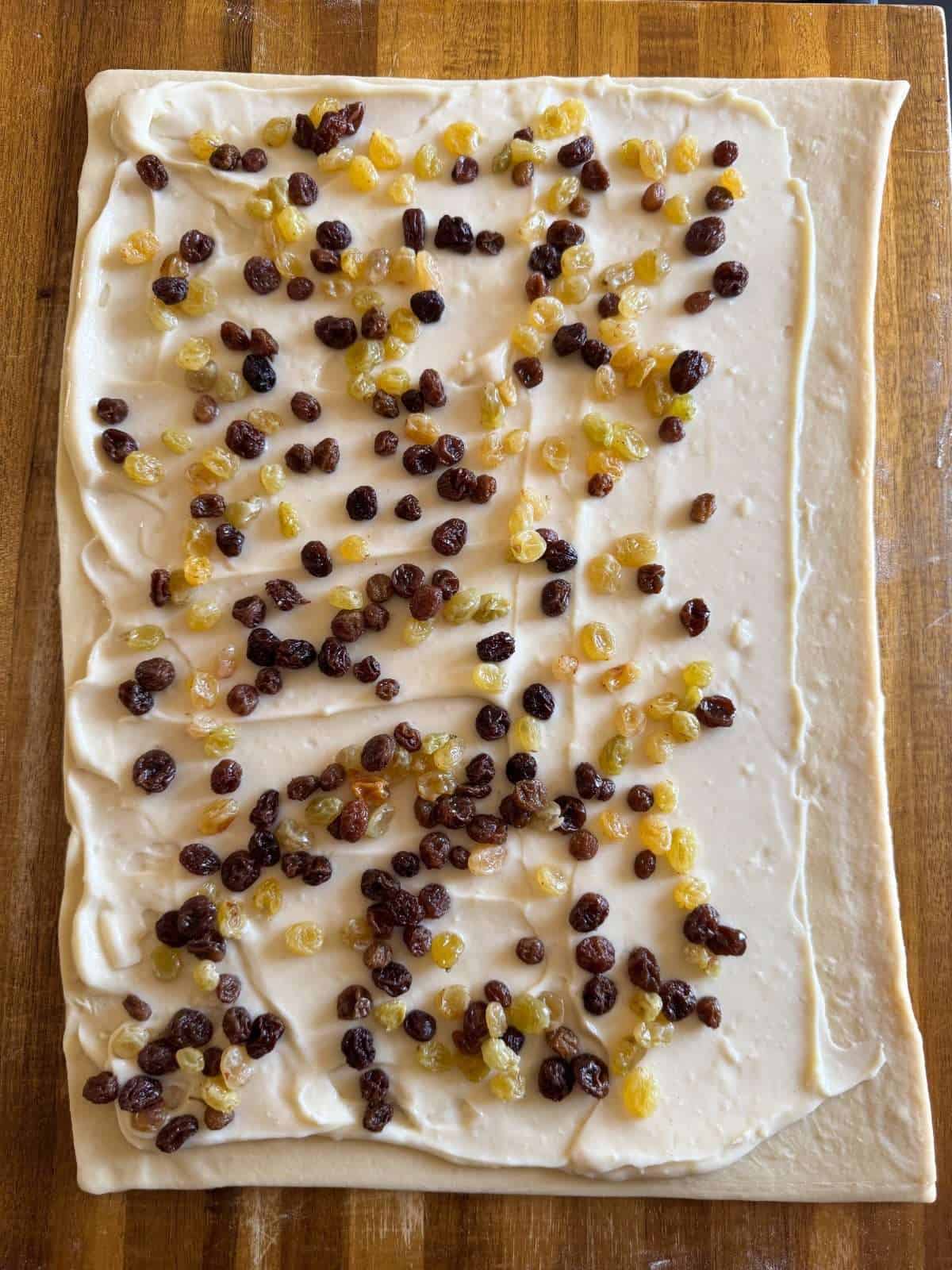
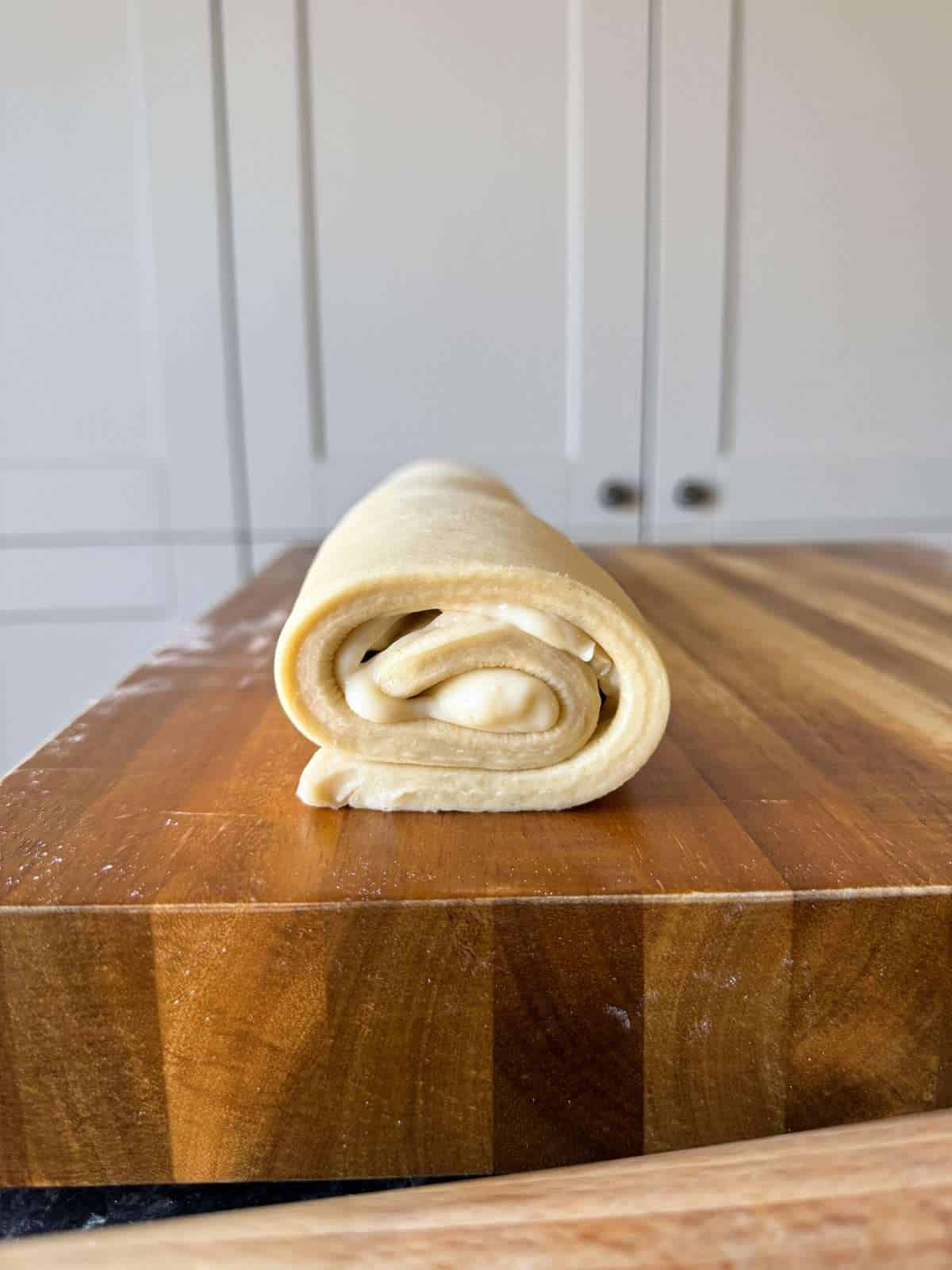
Spoon the pastry cream on top of the pastry then use a palette knife to spread it out into an even layer, leaving a 1 inch border on the longest side closest to you. Brush this border with a light layer of egg wash as this will help seal the pastry when you roll it up. - Roll Up
Scatter the soaked raisins evenly over the pastry cream then roll the pastry up into a tight sausage, starting at the longer edge that’s furthest away from you (the one without the border). Once rolled up, make sure that the pastry is sitting with the seam on the bottom. - Cut Into Pieces
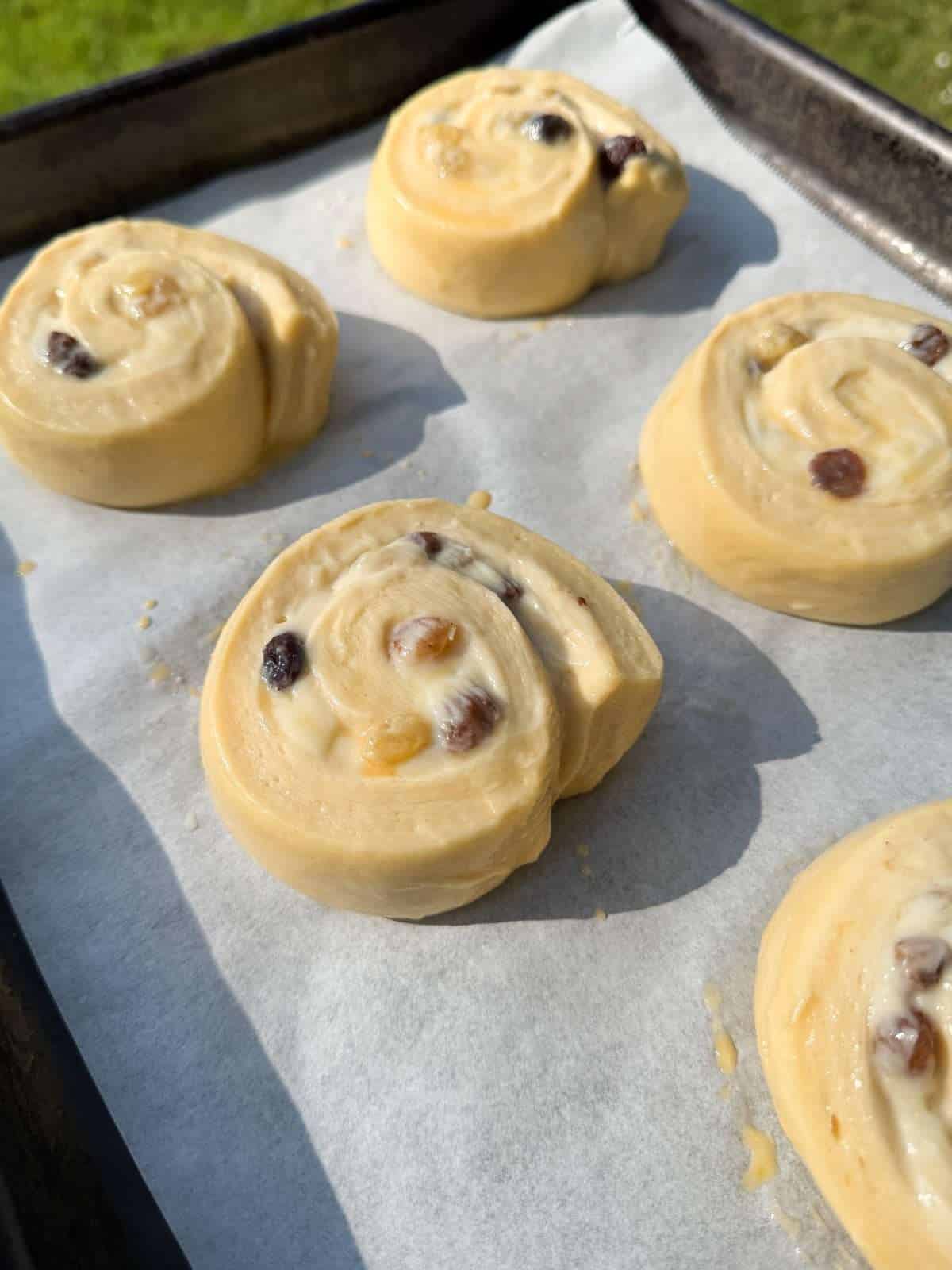
Next, use a sharp knife to cut the pastry into 4cm wide pieces then place them onto lined baking trays, leaving plenty of space between each piece. For the cleanest cuts, use a gentle sawing motion rather than pressing straight down. - Prove
Loosely cover the trays with clingfilm (or an upside down roasting tin) then leave to prove at room temperature for 2-3 hours, until the pastries are light & airy and they wobble when you gently shake the tray. Proper proofing is key, as under proofed pastries will leak butter as they bake. - Bake
Once proved, brush the tops & sides of each pastry with egg wash then bake at 220°c/428°f for 16-18 minutes until they’re well risen & a deep golden brown all over. Don’t be afraid to bake them quite dark, as this develops more flavour & crisp layers. Once cooked, the pastries should feel light & crisp on the outside but slightly soft in the centre. - Glaze
As soon as the Danishes come out of the oven, brush them with warm apricot jam to give them a glossy finish then leave to cool slightly before serving.
Pain Aux Raisin Tips & Tricks
- Homemade Danish Pastry
For the best flavour & texture, make your own Danish pastry! My full step by step guide can be found here. - For Plump Raisins
Soak the raisins in hot water for at least an hour then drain well before using. This makes the raisins extra plump & juicy! - Good Quality Vanilla
Use a vanilla pod or a good quality vanilla paste in the pastry cream, for the best flavour. Make sure to chill the pastry cream for at least 2 hours before using, so that it’s completely cold & set. This prevents the filling from leaking out as the pastries bake. - Leave A Border
Before rolling the pastry up, leave a slight border on one side without any filling on then brush with a light layer of egg wash. When you roll the pastry up, the egg wash will seal the edge & means that the danishes won’t unroll in the oven. - Proper Proving
Make sure not to under prove the Danishes; they take longer than you think! Danish pastries will take at least 2 hours to rise at room temperature but don’t let them get too warm though as this will the butter melt.
Troubleshooting Pain Aux Raisins
- My Danish Pastries Leaked Butter In The Oven
Butter will leak out of the pastry if it has been under proofed or if it got too warm. To avoid this, prove the pastry until it feels light & wobbly, at a lower temperature. A longer, slightly cooler prove is key! - The Layers In The Pastry Aren’t Flaky Or Defined
This happens when the pastry wasn’t laminated properly & the butter melts into the dough. To prevent this, make sure to keep the dough & butter cold and avoid over working it when you roll it out. - My Danish Pastries Unravelled In The Oven
You didn’t roll the pastry up tight enough or didn’t egg wash the seam. Make sure to leave a border along the edge & brush it with egg wash to properly seal. - The Custard Leaked Out In The Oven
Your pastry cream was too thin or hadn’t set properly. To avoid leaking custard, thicken it with cornflour & allow to set in the fridge for at least 2 hours before using. - My Pain Aux Raisin Aren’t Light & Airy
Under proofed pain aux raisins will be dense instead of light & airy. To avoid this, make sure to properly prove the pastries before baking. - My Danishes Browned Too Quickly
Your oven is too hot! Next time, make sure to double check the temperature of your oven with a thermometer or bake the pastries on a lower shelf.
Frequently Asked Questions
Because pain aux raisins contain custard, it’s best to store them in the fridge in an airtight container, where they’ll keep for up to 3 days. Although pain aux raisins are best eaten fresh! I’d recommend serving pain aux raisin warm or at room temperature (not straight from the fridge!).
The best way to reheat a pain aux raisin is to place the pastry onto a baking tray then bake in a 180°c/356°f oven for 5-6 minutes, until warmed through. Be careful not to bake for too long though, as you risk burning the pastry.
Pain aux raisins can be made with either croissant dough or danish pastry. The pastries made with croissant dough will be crisper & not as sweet and the pastries made with Danish pastry will be sweeter & slightly chewier.
To bake pain aux raisins in an Aga, bake them in the roasting oven, on the bottom set of runners for 14-16 minutes (turning them around after 12 minutes). Use the simmering plate to cook the pastry cream.
Yes, pain aux raisins can be frozen for up to 3 months. Make sure to store them in an airtight container to avoid freezer burn. You’ll need to defrost them fully then reheat before serving.
More Bakery Quality Recipes To Try
- Chocolate Fudge Layer Cake
- Brown Butter & Vanilla Glazed Cookies
- Brown Butter & Miso Pecan Pie Bars
- Savoury Double Pie Crust
- Kettle Chip Chocolate Chip Cookies
- Rapeseed Oil Lemon Drizzle Loaf Cake
If you have enjoyed this recipe for pain aux raisin Danishes, it would mean a lot if you could leave a review & rating. And if you’d like to stay up to date with future recipes, follow us on Instagram & TikTok or subscribe to our newsletter!

Pain Aux Raisin Danish Pastries
Equipment
- Saucepan
- Mixing Bowl
- Sieve
- Rolling Pin
- Baking Trays
Ingredients
Pastry Cream
- 250 g Whole Milk
- 50 g Caster Sugar
- ½ A Vanilla Pod (Or 1 tsp Vanilla Paste)
- A Pinch Of Sea Salt
- 40 g Egg Yolks
- 20 g Cornflour
- 15 g Unsalted Butter
Assembly
- 1 kg Danish Pastry Dough (See Notes)
- 130 g Raisins (See Notes)
- 1 Egg
- 1 tsp Whole Milk
Glaze
- 100 g Apricot Jam
- 2 tsp Hot Water
Instructions
Pastry Cream
- Add the milk, vanilla, salt & half of the caster sugar into a large saucepan then set over a low heat. Warm gently, stirring occasionally until steaming hot.If you're using a vanilla pod, scrape the seeds out then add both the pod & seeds to the milk.
- Whilst your milk is warming up, place the yolks, cornflour & remaining sugar into a mixing bowl & whisk by hand until pale, smooth & combined. This will take a minute or so.
- Once the milk is steaming hot, pour half of it into the yolks, whisking as you do so. Pour the now tempered yolks into the pan of milk.
- Increase the heat to medium then cook, whisking constantly until the custard is thick & starting to bubble. This will take around 3-4 minutes. If you take the temperature of the custard with a food probe, it should be around 85°c/185°f once cooked.To check if the custard is ready, stop whisking every 20-30 seconds once it has thickened. If a few bubbles appear & pop, the custard is ready. Be careful not to overcook it though!
- Once the custard is cooked, take the pan off the heat, whisk in the butter then pass through a sieve, into a bowl. Place a piece of baking parchment onto the custard's surface, leave to cool slightly then refrigerate until completely cold. This will take at least 2 hours.I like to make the pastry cream the night before so that it's ready to go the next day!
Assembly
- Before making the danishes, place the raisins into a bowl, cover with hot water then leave to soak for at least an hour. Drain the fruit well (through a sieve) before using. You'll also need to make an egg wash by whisking the egg & milk together in a small bowl.
- Roll the danish pastry out on a lightly floured work surface into a rectangle that measures 30x40cm & is roughly 5mm thick. If necessary, trim the edges slightly so that they are straight. Position the pastry so that it's sitting horizontally (landscape), with a longer side closest to you.For these pastries, you'll need a batch of my danish pastry dough. The dough should be chilled for at least 2 hours before making this recipe.
- Next, take the pastry cream out of the fridge & whisk by hand, until smooth & at a spreadable consistency. Spoon the pastry cream on top of the pastry then use a palette knife to spread it out into an even layer, leaving a 1 inch border on the longest side closest to you. Brush this border with a light layer of egg wash.
- Sprinkle the soaked raisins evenly over the pastry cream then roll the pastry up into a tight sausage, starting at the longer edge that's furthest away from you (the one without the border). Once rolled up, make sure that the pastry is sitting with the seam on the bottom.
- Lightly trim each end slightly then use a sharp knife to cut the pastry into 4cm wide pieces. Place the danishes onto lined baking trays as you cut them, leaving plenty of room between each one. Place the pastries onto the tray so that the cut edge is facing up, showing the filling.You should get 10 danishes. I find that cutting gently in a sawing motion helps get the cleanest slices.
- Next, cover the trays loosely with clingfilm (or an upside down roasting tin) & leave to prove at room temperature until the pastries are light & airy and wobble when you gently shake the tray. This will take between 2-3 hours.
Baking
- In the meantime, preheat an oven to 220°c/200°c fan (428°f/392°f).
- Once the danishes are ready to cook, brush the tops & sides with a light coating of egg wash then bake for 16-18 minutes, until they're well risen & a deep golden brown.Depending on the size of your oven, you may need to bake the pastries 1 tray at a time. I'd recommend turning the tray around after 12-14 minutes, so that they colour evenly.
- Whilst the danishes are baking, add the apricot jam & water into a bowl then stir to combine. Gently brush the top of the pastries with a good layer of jam as soon as they come out of the oven.If needed, warm the jam in a microwave to make it a more brush-able consistency.
Salt Butter Smoke Magazine
Food that’s made for sharing.
The Christmas 2026 issue features 30 festive recipes, Christmas cooking guides, beautiful food photography and features on everything from the perfect cheeseboard to the art of trifle.
Discover the Christmas Issue →Notes
Enjoying This Recipe?
The Prep List is my free weekly newsletter with seasonal recipes, kitchen notes and behind-the-scenes from my kitchen. Add Salt Butter Smoke as a Google Preferred Source to see more of my recipes in Search.