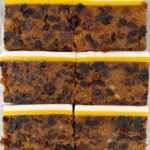
Marmalade Christmas Cake
Marmalade Christmas cake is a twist on the classic festive fruit cake. This version is flavoured with marmalade and orange liqueur then baked traybake style, for a more refined look.
Servings: 20 People
Equipment
- 9"x13" Baking Tin
- Large Mixing Bowl
- Wire Cooling Rack
Ingredients
Soaked Fruit
- 350 g Raisins
- 350 g Sultanas
- 250 g Prunes (Or Dates, Dried Figs Or A Mix)
- 200 g Dried Cranberries
- 200 g Glacé Cherries
- 150 g Dried Apricots (Or Dried Pears)
- 180 ml Grand Marnier (Or Brandy - See Notes)
Christmas Cake
- 350 g Unsalted Butter (Softened, Plus Extra For Greasing)
- 275 g Dark Brown Sugar
- 60 g Black Treacle
- 6 Large Eggs (Room Temperature - See Notes)
- 80 g Marmalade
- 300 g Plain Flour
- 100 g Ground Almonds
- 1 tsp Table Salt
- 1 tsp Baking Powder
- 1 tsp Almond Extract
- 1 tsp Ground Cinnamon
- ½ tsp Ground Allspice
- ¼ tsp Ground Nutmeg
- 100 g Candied Peel
- 50 g Stem Ginger (Drained - See Notes)
- Zest Of 1 Orange & 1 Lemon
- 75 ml Grand Marnier (For The 1st Feed)
To Feed
- Grand Marnier (Or Brandy)
To Finish
- 500 g Golden Marzipan
- 500 g White Fondant Icing
- 1 tbsp Marmalade
- ½ tbsp Vodka (Or White Rum - See Notes)
Instructions
Soaked Fruit
- Chop the prunes, dried apricots and glacé cherries into small pieces, roughly the same size as the raisins but no bigger than 1 cm.
- Add all of the dried fruit into a mixing bowl, pour over the Grand Marnier then stir to combine. Cover the bowl with clingfilm then leave to soak overnight.I'd recommend letting the fruit soak for at least 12 hours, so that it absorbs all of the alcohol.
Christmas Cake
- Preheat an oven to 140°c/120°c fan (284°f/248°f). Grease and line a 9"x13" baking tin as well. Make sure to use a tin that's at least 2.5" deep. You'll also need to cut a piece of baking paper the same size as the top of the tin and grease one side with butter.
- Add the softened butter, brown sugar and treacle into a large mixing bowl then beat with a wooden spoon until well combined and fluffy. You can use an electric hand mixer for this if you'd prefer.
- Next, add the eggs and almond extract into a jug then lightly beat together with a fork. Gradually mix the eggs into the butter a small amount at a time, making sure that each addition is incorporated fully before adding in more.
- Sift the plain flour, baking powder and ground spices into a separate mixing bowl, add in the ground almonds and salt then whisk to combine
- Add the dry ingredients into the cake batter then fold in gently with a spatula until just combined.
- Next, finely dice the stem ginger then add into the batter along with the soaked fruit, candied peel and zests. Fold gently to evenly distribute the fruit throughout the batter then transfer to the lined tin.If there's any excess liquid in the bowl of soaked fruit that hasn't been absorbed, strain this off first.
- Use a palette knife to spread the batter into an even layer then place the greased piece of baking paper from earlier, on top, facing butter side down.
- Place your Christmas cake into the preheated oven then bake for 2½-3 hours, until a skewer inserted into the centre comes out clean. Whilst your cake is baking, place the Grand Marnier (for the 1st feed) into a jug.
- As soon as your Christmas cake comes out of the oven, poke a few holes on top of the cake using a skewer then pour the Grand Marnier all over the top. Then leave to cool in the tin for an hour or so, until cool enough to handle.
- Next, carefully turn the cake out on a wire cooling rack, remove the baking parchment then leave to cool completely. Then wrap the cake in baking paper and a double layer of foil. Store in a cool, dry place to mature.A cupboard is the ideal place to store your Christmas cake. If you've got an airtight container, pop the wrapped cake in there. Due to the size of this Christmas cake, you need to be very careful when moving it, to avoid breaking or splitting the cake. The bottom of the cake becomes the top after you turn it out of the tin.
Feeding
- It's best to let this Christmas cake mature for at least 3 weeks and up to 2 months. I'd recommend feeding your Christmas cake with 1 tbsp of Grand Marnier (or brandy) once every 2 weeks if you're planning on maturing for longer or once a week for less time. A total of 3-4 feeds is best and you should stop the feeding process at least 1 week before you plan on icing the cake, so the surface has time to dry out slightly.
- To feed your cake, carefully unwrap the foil and baking paper then poke a few tiny holes in the top of the cake. Next, drizzle 1 tbsp of liqueur over the cake and leave to soak in. If the liquid is pooling on the surface, use a pastry brush to distribute the liqueur over the rest of the cake.I serve my Christmas cake facing bottom side up as this was the flattest. Make sure to feed the side you're planning on icing.
- Once you've fed your cake, carefully wrap it back up and return to where you've been storing it. If the parchment or foil tears, use fresh. If when you unwrap the cake, the surface looks damp or stodgy, you won't need to feed it anymore.
Marzipan Layer
- Make sure you've not fed your cake for at least 1 week before you're planning on finishing it.
- Before adding the marzipan, unwrap the cake then carefully transfer to a chopping board. You may find it easier to keep the cake on the baking paper at this point.
- Place the marmalade and 1 tbsp of hot water into a bowl, stir together then warm gently in the microwave until the mix is at a spreadable consistency. Pass the marmalade through a sieve, into a bowl then set to one side.
- Next, roll the marzipan out on a work surface that's been lightly dusted with icing sugar, into a rectangle that's just big enough to cover the top of the cake. The thickness of the marzipan should be around 5mm.Don't worry about covering the sides of the cake as we'll be trimming them flush with the icing before serving.
- Brush a thin, even layer of the marmalade over the top of the cake then carefully place the marzipan on top, pressing very lightly so that it sticks.
- Now you need to let the cake sit uncovered for 24 hours, so that the marzipan can dry out. This stops any oils from the almonds from leaking into the white icing.
Icing Layer
- Place your block of icing onto a clean work surface then knead gently by hand until it feels more pliable. This will only take a minute or so.
- Dust your work surface lightly with icing sugar then roll the icing out into a rectangle that's just big enough to cover the top of the cake & marzipan. The thickness of the icing should be around 5mm as well.
- Next, brush a very light layer of clear liqueur (vodka or white rum is best) on top of the marzipan then carefully lay the icing on top. Cooled boiled water will work too.
- Roll a small amount of the overhanging icing into a ball then use this to massage/mould the icing so that the top has a smooth, flat surface. Let the cake stand for 10 minutes or so, so that the icing can stick properly before slicing.An icing smoothing tool will work too!
Serving
- To finish the cake, use a sharp knife to lightly trim the 4 edges flush with the icing and marzipan. Then you can cut the cake into your desired sized pieces then serve! If you're not serving straight away or you're gifting cake to people, I'd recommend cutting the cake into slightly smaller pieces then wrap each in clingfilm to keep airtight.I use a serrated knife for this, slicing in a gentle sawing motion.
Salt Butter Smoke Magazine
Food that's made for sharing.
The Christmas 2026 issue features 30 festive recipes, Christmas cooking guides, beautiful food photography and features on everything from the perfect cheeseboard to the art of trifle.
Discover the Christmas Issue →Notes
1. To Bake In An Aga - If you're using an Aga to bake your Christmas cake, you'll need to bake it on a grid shelf placed onto the floor of the simmering oven. The cake will take longer to bake in an Aga, I'd recommend that you check it after 4 hours.
2. Tin - For this cake, you'll need to use a 9"x13" tin that is at least 2.5" deep. I use a Nordic Ware baking tin.
3. Alcohol - I used an orange liqueur (Grand Marnier) for my Christmas cake to complement the flavour of the marmalade. If you'd rather use the more traditional brandy for soaking the fruit and for feeding, this will work great too. Or you could use Grand Marnier for soaking the fruit and brandy for feeding the cake.
4. Fruit - You can use pretty much whatever mix of dried fruit that you like for Christmas cake, providing that the total amount is the same. This recipe is a great way to use up dried fruit that you may have in your cupboard! I used a mix of raisins, sultanas, cranberries, prunes, dates, apricots, dried figs, dried pears and glacé cherries.
5. Storage - Christmas cake is designed to be made several weeks or even months before serving, to give the flavour time to develop. However, if you're planning on making it more than 2-3 months ahead of time, I'd recommend storing it in the freezer once it has matured.
6. Marzipan - I like to use golden marzipan for my Christmas cakes but white marzipan will work too. For this cake you'll need a 500g block of marzipan which is the size that most supermarkets sell.
7. Stem Ginger - I use stem ginger in syrup for this recipe and you'll need to drain it well before chopping. If you'd prefer, you can use 1 tsp of ground ginger instead of the stem ginger.
8. Trimmings - Don't throw the cake trimmings away! You can use them to make Christmas cake ice cream or use it instead of Christmas pudding in my Christmas pudding flapjack. You can simply serve the trimmings with ice cream or even custard, for an easy festive dessert.
Enjoying This Recipe?
The Prep List is my free weekly newsletter with seasonal recipes, kitchen notes and behind-the-scenes from my kitchen. Add Salt Butter Smoke as a Google Preferred Source to see more of my recipes in Search.