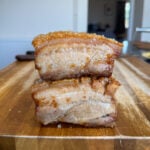
Confit Pork Belly (3 Day Method)
The ultimate twice cooked pork belly with tender meat and the crispiest crackling! The secret to making restaurant style pork belly at home is all in the 3 day process.
Servings: 12 People
Equipment
- Mixing Bowl
- Pestle & Mortar
- Small Frying Pan
- Large Roasting Tin
- Digital Food Probe
- Cooling Rack
Ingredients
- 3 kg Pork Belly (Boneless - See Notes)
1.5% Salt Cure
- 2 tsp Fennel Seeds
- 1 tsp Black Peppercorns
- 45 g Fine Sea Salt (1.5% Of Pork Belly Weight)
- 2 tsp Finely Chopped Rosemary
- 6 Garlic Cloves (Grated)
- 1 Orange (Zested)
- 1 Lemon (Zested)
To Confit
- 500 g Lard
- 1 Litre Vegetable Oil
To Roast
- Vegetable Oil
- Sea Salt
Instructions
Cure
- Add the fennel seeds into a small frying pan then cook over a medium-low heat for 2-3 minutes until toasted and fragrant. Transfer the seeds to a bowl then leave to cool.
- Next, coarsely crush the toasted fennel seeds in a pestle & mortar then transfer to a small bowl. Do the same with the black peppercorns.
- Add the sea salt, grated garlic and zest into the bowl then stir to combine.This is a 1.5% salt cure, which means it uses 1.5% of the weight of the pork in salt. If your pork belly is a different weight, adjust the cure accordingly.
- Lay a double layer of clingfilm down onto your work surface then place the pork belly on top, facing skin side down. Sprinkle the cure all over the meat (including the sides!) then tightly wrap the belly in the clingfilm. Try not to get the cure on the skin.
- Place the pork belly into the fridge (skin side down) then leave to cure for 24 hours.Cure the pork for at least 18 hours but no longer than 36. 24 hours is the sweet spot!
- Once cured, give the pork belly a good rinse under cold water to remove any excess cure then pat dry with kitchen paper. Then place the pork skin side up onto a tray lined with kitchen paper and leave uncovered in the fridge for at least 1 hour.This gives the pork time to dry properly.
To Confit
- Preheat an oven to 100°c/80°c fan (212°f/176°f).
- Add the lard into a heatproof jug then microwave until melted. Alternatively, melt the lard in a pan set over a low heat.
- Place the pork belly into a large roasting tin (skin side up). Pour the lard over the pork belly then enough vegetable oil to completely submerge the pork in fat. I used 1 litre of oil for this but it will depend on the size of your tin & the thickness of the belly.
- Lay a sheet of baking parchment over the pork belly then cover the tin with tin foil, making sure that it's wrapped tightly.
- Place the pork into the preheated oven then cook until a food probe (or skewer) slides into the meat with very little resistance. This will take between 6-8 hours but don't worry if it takes slightly longer.The meat should feel soft like butter!
- Once cooked, let the pork cool in the fat for 30 minutes then carefully transfer to a wire rack set over a tray and leave to drain for 10 minutes.
- Pass the leftover confit fat through a sieve, into a container then leave to cool before chilling in the fridge. You can use it to cook more pork belly or for roast potatoes!
Pressing
- Lay a double layer of clingfilm down on your work surface then lay the pork belly on top. Wrap the pork belly in the clingfilm so that it is completely sealed.Make sure to use enough clingfilm to completely cover the pork belly.
- Next, place the pork belly onto a baking tray then place another tray on top. Weigh the top tray down with something heavy. I used 4x 2kg weights but cast iron pans, large tins from your cupboard, bags of sugar or other heavy items will work. Try to aim for 6-8kg and arrange them so the tray sits flat on top of the pork belly.
- Transfer the pork belly to the fridge then leave to chill overnight (at least 12 hours).
Roasting
- Preheat an oven to 220°c/200°c fan (428°f/392°f).
- Take the pressed pork belly out of the fridge, remove the clingfilm then transfer to a chopping board.
- Using a large, sharp knife, lightly trim the edges to square up the pork belly. Then you can either cut the pork belly in half down the length and cut into 2" pieces, roast the whole belly or cut a large piece off and save the rest for another day.
- Next, use a sharp knife to score the skin (either in a cross hatch pattern or horizontal lines) then place the pork onto a rack set inside a roasting tin.I like to line the tin with foil, to make cleaning up easier. The pork will release quite a bit of fat as it roasts!
- Drizzle the pork skin with vegetable oil, rubbing it in with your hands then season the skin generously with sea salt.
- Roast the pork belly in the preheated oven for 20-25 minutes, until the skin has crisped up and the meat is hot. If you wanted to take the internal temperature with a food probe, it should be at least 75°c/167°f. Once roasted, serve the pork straight away.
Salt Butter Smoke Magazine
Food that's made for sharing.
The Christmas 2026 issue features 30 festive recipes, Christmas cooking guides, beautiful food photography and features on everything from the perfect cheeseboard to the art of trifle.
Discover the Christmas Issue →Notes
1. To Cook In An Aga - Confit the pork belly in the simmering oven, on the bottom set of runners. Roast the pressed pork belly in the roasting oven, on the second from bottom set of runners.
2. Pork Belly - This recipe will work with any size pork belly. If yours has the bones attached, make sure to trim them off before cooking. You'll get a more even slab of pork belly once pressed and the meat won't take as long to cook.
3. Curing - This confit pork uses a 1.5% cure which means it uses 1.5% of the weight of the pork in salt. If your pork belly is a different weight, adjust the cure accordingly. To calculate this, multiply the weight of the pork (in grams) by 0.015. Make sure to use a fine sea salt as well, otherwise the meat will be too salty. I used Maldon salt.
4. Internal Temperature - It's best to cook pork belly until the meat feels soft when you poke the meat with a food probe/skewer. It should slide in with little to no resistance. Though if you wanted an internal temperature as a guide, aim for at least 75°c/167°f.
5. Pressing - You don't have to press the pork belly if you don't want to. The reason for doing it is to make the meat an even thickness, meaning that you get even pieces. It also means that you get evenly crisp skin.
6. Storage - Pork belly should be stored in the fridge and is best eaten within 3 days. Make sure to store the pork in an airtight container or wrapped tightly in clingfilm.
Enjoying This Recipe?
The Prep List is my free weekly newsletter with seasonal recipes, kitchen notes and behind-the-scenes from my kitchen. Add Salt Butter Smoke as a Google Preferred Source to see more of my recipes in Search.